
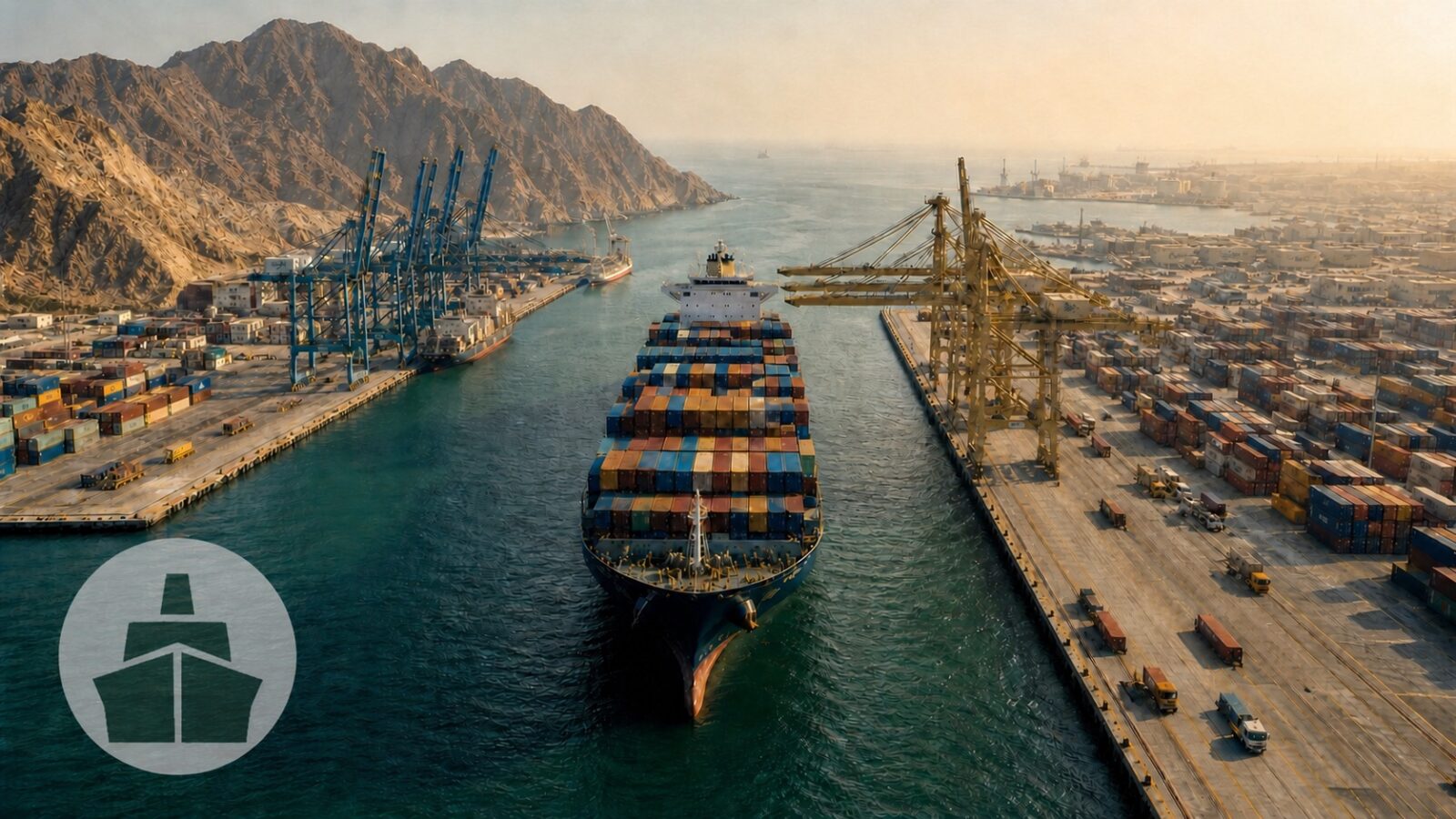
Since transits through the Strait of Hormuz were disrupted, a great deal of Gulf-bound cargo has been discharged on the UAE’s east coast instead of at Jebel Ali. It is often described as a simple swap — same country, different quay, add a truck. It is not. The routing change alters which cargo can be booked at all, where the carrier’s contract ends, who holds the risk after discharge, which clocks start running and when, and what it costs to give the empty back.
This note sets out what the five largest container lines have actually published, with the figures as stated and dated. It takes no view on the causes of the disruption and describes only operational and contractual consequences.
The scale, in the terminal operator’s own numbers
DP World’s half-year results put the change in context better than any commentary. Container volumes at its flagship Jebel Ali terminals fell 90.1% year on year in the second quarter, with first-half throughput of 3.1 million TEU, down 59.5%. Over the same period group revenue rose 13.1% to USD 12.7 billion, and container volumes across the wider portfolio were up 6.5% excluding Jebel Ali.
Read together, those two numbers say something useful for planning: this is a corridor problem, not a demand problem. The cargo has not stopped. It is arriving somewhere else.
That distinction matters, because it determines whether you are managing a temporary interruption or re-planning a route. The published investment follows the same logic — roughly USD 3 billion earmarked for 2026, and an agreement in principle with the Fujairah Ports Authority to develop two east-coast terminals under a 50-year concession.
What the five largest lines have published
Every major carrier has introduced a charge to cover the additional cost of serving the region. They are not equivalent, they are not all called the same thing, and they do not all attach to the same event. The figures below are each carrier’s own published amounts.
| Carrier | Charge | 20′ dry | 40′ dry | Reefer / special | Stated effective |
|---|---|---|---|---|---|
| Maersk | Emergency Freight Rate | USD 1,800 | USD 3,000 | USD 3,800 | 2 Mar 2026, restated 19 Aug 2026 |
| CMA CGM | Emergency Conflict Surcharge (ECS) | USD 2,000 | USD 3,000 | USD 4,000 | 2 Mar 2026 |
| Hapag-Lloyd | War Risk Surcharge (WRS) | USD 1,500 per TEU | USD 3,000 (2 × TEU) | USD 3,500 | 2 Mar 2026 |
| MSC | End of Voyage surcharge | USD 800 per container, flat — see below, this one is different in kind | 9 Mar 2026 | ||
| COSCO | No published tariff located. Bookings suspended in early March and reopened to the UAE, Saudi Arabia, Bahrain, Qatar, Kuwait and Iraq from 25 March 2026. | 25 Mar 2026 | |||
Each carrier’s own published figures. Amounts and scope are revised frequently — verify against the current advisory before quoting a customer.
Three additions are easy to miss because they sit outside the headline table. Maersk applies a further USD 1,000 per container where a vessel transits the Strait, stated to cover insurance premiums and crew risk compensation, and to replace its separately charged landbridge cost. Hapag-Lloyd has a Middle East Emergency Surcharge that for dangerous goods to the UAE is published at USD 2,300 per 20′ and USD 3,300 per 40′ DG container, plus an Emergency Operations Charge of USD 35 per TEU on feeder services from 1 May 2026. Maersk’s Emergency Bunker Surcharge sits on top again.
MSC’s End of Voyage: the clause that matters more than the money
The USD 800 in the table above is not a surcharge in the ordinary sense, and treating it as one is a mistake worth avoiding.
On 9 March 2026 MSC declared an End of Voyage for certain export shipments under its custody from ports in the Gulf, invoking Clause 13 (Special Circumstances) of its Sea Waybill and Bill of Lading terms. The advisory states plainly that the measure “does not constitute a breach of contract”. It applies to cargo ashore and already onboard, and to empty containers already released for stuffing.
The practical effect is what matters. Affected cargo is discharged and made available at a designated port, and from that point custody, risk and responsibility transfer to cargo interests. Costs of discharge, handling and storage fall to the cargo. Continuing the journey with the same carrier requires a new and separate contract of carriage — the USD 800 covers arranging that alternative, not completing the original one.
A shipper who assumes the original bill of lading still governs the onward leg is working from a contract that has already ended.
That has consequences your customer will feel. If you sold on CIF or CFR, your delivery obligation and your insurance both assumed carriage to a named port that the carrier is no longer sailing to. If you bought on those terms, the goods may now be sitting somewhere at your risk and cost while you believe them to be in transit.
What can and cannot be booked — the part most shippers discover too late
The most common misconception about the east coast is that it accepts everything Jebel Ali accepted. On the published position of the largest carrier by advisory detail, it does not. This is Maersk’s stated booking acceptance as at 19 August 2026:
| Cargo type | Position for the UAE |
|---|---|
| Dry | Suspended to and from the UAE except Khor Fakkan (import only) and Jebel Ali via landbridge. |
| Reefer | Suspended, excepting Khor Fakkan — import only — and Jebel Ali via landbridge. Critical foodstuff, medicine and perishables given special attention. |
| Dangerous goods | Suspended to and from the UAE including Khor Fakkan. Accepted to Sohar except IMO 5.1. |
| Out of gauge | Suspended to and from the UAE including Khor Fakkan. Transhipment via Salalah to non-upper-Gulf destinations remains open. |
| In-gauge breakbulk | Suspended to and from the UAE. Khor Fakkan accepted. |
Read that table against your own book. If you move chemicals and fertilizers, hazardous classes, or project and out-of-gauge cargo, the east coast is not currently a substitute route at all with this carrier — it is a closed door, and the answer is a different carrier, a different hub, or a different mode. That is a materially different planning problem from “add a truck leg”, and it is not visible until the booking is attempted.
Dangerous goods: the Sajaa routing requirement
Where DG does move through the east coast, the inland routing has changed in a way that carries real cost. All dangerous goods destined for the local market must be routed through Sajaa (ICD), with Class 5.1 and radioactive excepted. Direct delivery from the terminal to the local market is no longer permitted for the remaining classes.
Three details in that arrangement are worth pricing before you book:
- Containers are transferred to Sajaa on the day of availability, but onward trucking from Sajaa is the customer’s own arrangement.
- Storage at Sajaa ICD is on the customer’s account, and accrues while that trucking is organised.
- The delivery order and customs formalities must be completed before the vessel discharges, not after. Working to the old sequence means the box lands into storage you are paying for.
Documentation must be lodged before acceptance: dangerous goods declaration, safety data sheet, container packing certificate where applicable, line approval and any regulatory permits, all to the current IMDG Code. Our dangerous goods reference sets out the classes and the paperwork each one attracts.
Empty containers: the cost nobody budgets for
This is the line item that surprises people, because returning an empty has historically been free and unremarkable. Empties are no longer accepted at their usual return locations across much of the region; designated depots are Salalah and Jeddah, with limited acceptance elsewhere against a drop-off charge.
| Drop-off location | 20′ | 40′ | Reefer |
|---|---|---|---|
| Oman — Sohar & Salalah | Free | Free | Free |
| Saudi Arabia — Jeddah | Free | Free | Free |
| UAE — Abu Dhabi | USD 600 | USD 1,200 | USD 1,200 |
| UAE — Jebel Ali (from 17 Jul 2026) | USD 1,000 | USD 1,200 | USD 1,200 |
| UAE — Ajman | USD 2,055 | USD 2,175 | USD 2,175 |
| Kuwait | USD 400 | USD 800 | USD 800 |
| Qatar (from 27 Jun 2026) | USD 600 | Free | USD 1,200 |
| Bahrain | Free | Free | USD 1,250 |
Maersk published drop-off charges. A separate pick-up charge applies at non-preferred collection points — Jebel Ali is free for 20′ and USD 300 for 40′ and reefer, effective 6 April 2026.
A single 40′ returned in Ajman rather than Salalah is a USD 2,175 decision. On a ten-container movement that is more than the freight on some lanes, and it is entirely avoidable if the return point is agreed before the boxes are collected rather than after they are empty.
Three clocks, three different parties billing you
Routing through a storage or transhipment point multiplies the number of charges running against a single container. They are separate, they start at different moments, and they are invoiced by different parties.
| Charge | When it starts | Published rate | Billed by |
|---|---|---|---|
| Storage in transit | Day 15 — the Emergency Freight Rate covers the first 14 days | USD 25 per TEU per day, invoiced fortnightly | Carrier |
| Transhipment storage at Jebel Ali | The day of discharge — no free period | USD 25 per TEU per day, plus reefer plug-in at actuals | Carrier, to the freight payer |
| Import or COD storage at Jebel Ali | Per terminal tariff | Terminal tariff | Terminal, direct to you |
| Detention | When bill of lading free time expires | Local tariff at the designated return location | Carrier |
The second row is the one that catches people. Cargo remaining under transhipment accrues storage from the day of discharge, with no free period at all — a different treatment from the fourteen days allowed on storage in transit, and from the free days a straightforward import would attract. Our Jebel Ali port storage calculator and detention calculator walk the published bands if you need to model the exposure.
One further provision is worth knowing: where a cross-border return to a designated depot is unlawful or is materially prevented by the authorities, the carrier asks to be contacted within seven days to agree a compliant interim arrangement. Miss that window and you are arguing about detention after the fact rather than agreeing terms in advance.
If your cargo is already moving
For containers already en route, the published options resolve to three, and the timing of the decision changes the cost more than the decision itself.
| Option | What it costs | The catch |
|---|---|---|
| Complete the voyage, with storage | Emergency Freight Rate, covering 14 days of storage; USD 25 per TEU per day thereafter | The storage port is selected by the carrier, not by you. The carrier reserves the right to declare abandonment of carriage, in which case no waivers or refunds apply to charges already billed. |
| Return to origin | Standard change-of-destination fee and differential freight | Decide before the box reaches the affected region and the Emergency Freight Rate does not apply. Decide after arrival, or within 72 hours of planned discharge, and it does. |
| Change of destination | Standard change-of-destination fee and differential freight | Same 72-hour rule. And if you switch to this after first electing to complete the voyage, the Emergency Freight Rate continues to apply and is not refunded. |
The commercial lesson is unusually clear. The cheapest decision is the early one, and the window is measured in days.
Insurance has narrowed, and it is a separate exposure
Carrier charges are the visible cost. The quieter change is in cover. Carriers have noted that a number of insurers have reduced or withdrawn coverage for shipments into the Red Sea, Gulf of Oman and Gulf regions, particularly in respect of cover on the vessels themselves.
Two practical points follow. First, cargo cover and hull cover are different things, and a reduction in the latter can affect which vessels will serve a route long before it affects your policy. Second, if you have assumed war risk is included in a standard cargo policy, that assumption needs checking rather than carrying — the position has moved during 2026 and notices of cancellation have been issued at short notice. Our cargo insurance page covers what an all-risks policy does and does not reach.
What to do before your next booking
- Check acceptance for your specific commodity, not for the port. “Khor Fakkan is open” is true for dry imports and false for dangerous goods and out-of-gauge with at least one major carrier. The port status tells you very little on its own.
- Establish where the carrier’s contract ends. Ask explicitly whether an End of Voyage may be declared on your routing, and where. If the answer is yes, your Incoterms and your insurance both need reviewing before the vessel sails.
- Agree the empty return point before the boxes are collected. The difference between a designated depot and a convenient one is currently up to USD 2,175 per unit.
- Model all three clocks, not just detention. Transhipment storage runs from the day of discharge with no free period.
- Confirm war risk cover in writing. Do not rely on last year’s policy summary.
- Decide early on cargo already moving. Seventy-two hours before planned discharge is the line between a change-of-destination fee and a change-of-destination fee plus the full emergency rate.
For current FCL and LCL options into the UAE, see our sea transport service; for cargo that needs transfer after discharge, see our Jebel Ali cross-stuffing operation.
Where this leaves the UAE as a consolidation point
It would be easy to read the Jebel Ali figures as a verdict on the UAE’s role in regional trade. The wider numbers do not support that. UAE non-oil foreign trade reached a record AED 1.937 trillion in the first half of 2026, up 13%, with non-oil exports up 23.9%. The country has now signed 38 comprehensive economic partnership agreements, and non-oil trade with India alone ran to AED 107.5 billion in the same half.
The demand for consolidation, splitting and re-export through the UAE has not weakened. What has changed is the routing that serves it, the paperwork that governs it, and the cost of getting it wrong.
If you are working out what your own cargo should do — which carrier will accept it, where it should be transferred, and what the total landed cost looks like once the surcharges, storage and empty return are counted — send us the details and we will work it through with you against the current position rather than the published one.
Sources
- Maersk, Middle East Operational Update 43, 19 August 2026 — emergency freight rates, storage, empty return and pick-up charges, booking acceptance by cargo type, dangerous goods routing, detention provisions.
- CMA CGM, Advisory #2 — Middle East: Emergency Conflict Surcharge, 2 March 2026.
- Hapag-Lloyd, War Risk Surcharge, 2 March 2026, and Implementation of Middle East Emergency Surcharge (MES), June 2026.
- MSC, Important Notice — End of Voyage Declaration for Exports from the Arabian and Persian Gulf, 9 March 2026.
- COSCO Shipping Lines booking position, as reported March 2026.
- DP World, half-year results 2026.
- UAE Ministry of Economy non-oil trade figures, first half 2026.
Figures are as published by each carrier on the dates shown and are revised frequently. This note is provided for general guidance and is not a quotation, an offer, or advice on any specific shipment. Confirm the current position with the carrier or with us before contracting.
Published 23 August 2026 · updated 30 August 2026 · All insights →