
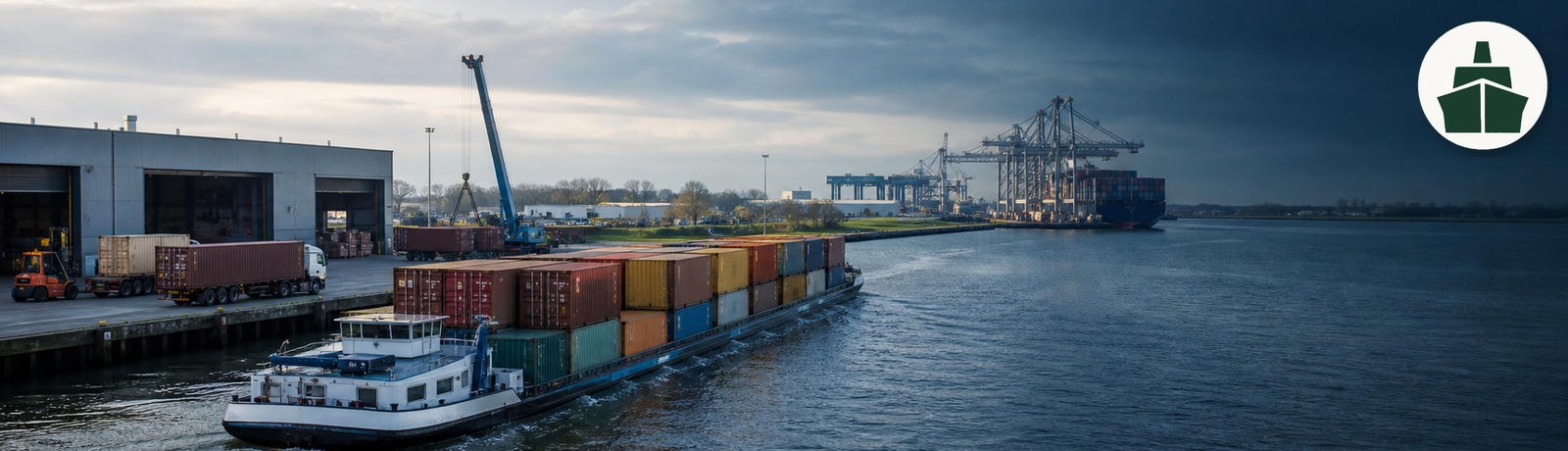
The Netherlands is the most efficient container origin in Europe and, for that reason, the most commonly misunderstood. Because Rotterdam handles so much and handles it so well, shippers tend to treat the Dutch leg as a solved problem — book to Rotterdam, done. That works, and it frequently leaves money and days on the table.
The country’s real advantage is not one port. It is a dense, interlocking network of seaports, barge terminals and inland hubs connected by some of the best waterway infrastructure in the world, in which cargo can be staged, consolidated and moved by water almost to the factory gate. Using that network deliberately — rather than defaulting to a truck and a Rotterdam booking — is where the difference is made on a UAE shipment.
We have worked the Netherlands–UAE lane for over ten years, with established partners handling the origin side directly, and our contracted warehouse at Alblasserdam, a short distance from the Rotterdam port area. That last point matters more than it sounds, and we will come back to it.
The seaports
Rotterdam is Europe’s largest port and the default gateway for good reason: the widest choice of services to the Gulf, deep water, the best onward connections in every direction, and the operational depth to absorb problems that would derail a smaller port. For most UAE-bound cargo it is the right answer. Its weakness is its scale — at peak, road access and terminal turnaround can be slower than the port’s reputation suggests, which is precisely why the barge network exists.
Amsterdam is smaller in containers and stronger in breakbulk, project and general cargo. For heavy or awkward pieces originating in the north of the country, and for cargo that would otherwise fight for a slot at a Rotterdam container terminal, Amsterdam frequently produces a simpler routing. It also serves the North Sea Canal industrial area directly.
Moerdijk sits between the two in character — a seaport with a strong inland orientation, positioned on the Hollands Diep with excellent barge and rail links, and a substantial chemical and industrial cluster around it. For shippers in North Brabant it is often closer, quieter and cheaper to work through than Rotterdam, with barge feeder to the deep-sea terminals.
The inland terminals
These are the hubs that make the Dutch network work, and using the right one can remove both cost and risk from the pre-carriage leg:
| Terminal | Serves | Why it matters for UAE cargo |
|---|---|---|
| Nijmegen | Gelderland, eastern Netherlands | On the Waal, the busiest inland waterway in Europe. Frequent barge shuttles to Rotterdam; the natural staging point for eastern Dutch and border-region cargo. |
| Venlo | Limburg, German border | One of Europe’s major logistics clusters. Rail, barge and road; the obvious consolidation point for cargo combining Dutch and German origins. |
| Tilburg | North Brabant | Strong rail terminal with direct services; serves the Brabant manufacturing and distribution belt. |
| Born | Southern Limburg | Barge terminal on the Juliana Canal; efficient for the southern industrial region and for cargo staged from Belgium and western Germany. |
| Utrecht | Central Netherlands | Central position with good barge access; useful for consolidating distribution-centre cargo from the country’s logistics core. |
The practical value of these terminals is not only cost. Barge pre-carriage moves cargo to the seaport on a predictable schedule that is largely immune to road congestion, and it allows a container to be staged close to the quay several days before the vessel without incurring terminal storage. On a tight cut-off that flexibility is worth more than the freight saving.
For the ocean leg, our sea freight service covers FCL and LCL between European gateways and the UAE.
Where the cargo discharges in the UAE
Jebel Ali is the primary gateway for Dubai and the northern emirates, and the right choice where cargo needs consolidating, splitting between consignees, or preparing for onward re-export. Our cross-stuffing facility sits there.
Abu Dhabi, through Khalifa Port, is the correct destination for cargo going to the emirate itself and to KIZAD-based industry — and for a good deal of the energy and process equipment that moves on this lane. Routing it through Jebel Ali and trucking south adds a day and a handling that is often unnecessary.
Fujairah, on the Gulf of Oman and outside the Strait, is a genuine alternative where routing reliability matters more than the shortest transit on paper.
Our contracted warehouse at Alblasserdam
Most forwarders quoting this lane are arranging storage through a third party. We also have our own contracted facility at Alblasserdam, minutes from the Rotterdam port area, and it changes what we can offer in three specific ways.
- Cargo can arrive early without penalty. Suppliers rarely finish to schedule. Being able to receive goods days or weeks ahead of the booking, at our own facility rather than against a terminal clock, removes the most common source of demurrage on European exports.
- Multi-supplier consolidation is straightforward. Goods from several Dutch, Belgian and German suppliers can be received, checked, counted and combined into full container loads under one bill of lading, with a tally we produce ourselves.
- Cargo can be inspected, repacked or re-marked before it sails. Damaged outer packaging replaced, palletisation corrected, labelling brought into line with the destination’s requirements — done at origin, where fixing it is cheap, rather than at destination where it is not.
Our warehousing service covers the facilities in more detail.
What we do on this lane
- Choose the port and the pre-carriage mode together. Rotterdam is usually right; Amsterdam and Moerdijk are sometimes better, and barge is frequently better than road. We compare rather than default.
- Consolidate across borders. Dutch cargo very often combines with German and Belgian volume. The Netherlands is the natural place to bring that together.
- Handle the documentation at both ends — export clearance, certificates of origin, legalisation where the UAE consignee requires it, and import clearance on arrival.
- Manage hazardous cargo properly. The Dutch and Belgian chemical clusters generate significant IMDG volume. Declarations, classification and segregation checked before the container reaches the terminal.
- Engineer the oversized pieces. Flat racks, open tops, lashing calculations and route surveys where the inland leg needs one.
- Track free time from the point of booking, because detention exposure is decided long before arrival.
Ten years on the lane
Three things a decade on Netherlands–UAE has actually produced.
Partners who do the origin work directly — collection, inland movement, export clearance and terminal delivery handled by people with hands on the cargo, not subcontracted onward.
Working relationships with the lines serving this trade. The useful part is not the rate. It is equipment when boxes are tight, a straight answer on whether a booking will load, and someone who will engage on a rolled container.
Knowing where the lane goes wrong — barge schedule compression before a holiday period, the gap between a quoted and a realistic transit on a relayed service, which terminals accept a late correction gracefully. Unglamorous, and most of the job.
Frequently asked questions
Usually, but not automatically. Rotterdam offers the widest choice of services to the Gulf and the operational depth to absorb problems, which is why it is the default for most UAE-bound cargo. Amsterdam is often the better answer for breakbulk, project and oversized pieces, particularly from the north of the country. Moerdijk can be closer, quieter and cheaper for shippers in North Brabant, with barge feeder onward to the deep-sea terminals. The right comparison is total door-to-port cost and total transit, including pre-carriage and the realistic sailing options in the week you need — not the ocean rate alone.
Frequently, yes, and it is under-used. Barge from an inland terminal such as Nijmegen, Venlo, Tilburg, Born or Utrecht is cheaper per unit than road, and because it runs on a fixed schedule on the waterway it is largely immune to the road congestion that affects Rotterdam access at peak. It also lets a container be staged near the quay several days ahead of the vessel without running a terminal storage clock. The trade-off is that barge is slower and less flexible at short notice, so it suits planned volume better than urgent movements. For a regular flow it is usually the better structure; for a last-minute shipment, road.
Yes — we hold our own warehouse at Alblasserdam, close to the Rotterdam port area, rather than arranging storage through a third party. Cargo can be received well ahead of the booking, which removes the most common cause of demurrage on European exports: a supplier finishing early or late against a fixed vessel. While it is with us the goods can be checked, counted, consolidated with cargo from other suppliers, repacked where the original packing will not survive the voyage, and re-marked to the destination’s requirements. Our warehousing service sets out the facilities across the UAE, the Netherlands and Germany.
Yes, and the Netherlands is usually the right place to do it. The inland network reaches comfortably into western Germany and northern Belgium, and Venlo in particular is well positioned for combining Dutch and German origins. We receive from each supplier, consolidate into full container loads and issue one bill of lading, which converts several part-loads and several freight bills into a single shipment. Where the cargo needs splitting again between different UAE consignees on arrival, our cross-stuffing operation at Jebel Ali handles the transfer with a full tally and photographic record.
Jebel Ali for Dubai and the northern emirates, and for anything needing consolidation, splitting or re-export. Khalifa Port for cargo destined for Abu Dhabi itself and for KIZAD industry, including much of the energy and process equipment on this lane — sending it via Jebel Ali and trucking south is common and frequently avoidable. Fujairah sits outside the Strait on the Gulf of Oman and is a real option where routing reliability matters more than the shortest paper transit. The answer follows the final delivery address and the urgency of the cargo.
Both. The Dutch and Belgian chemical clusters generate substantial IMDG volume and it is routine work — classification, dangerous goods declaration, safety data sheet, packing certificate and segregation, all verified before the container reaches the terminal rather than after it is rejected there. For oversized pieces we handle flat rack and open top loading, engineered lashing and route surveys where the inland leg requires one. One current caveat worth raising early: carrier acceptance for dangerous goods and out-of-gauge into the UAE is more restricted than usual at present and varies by line and by discharge port, so both need confirming per shipment rather than assumed.
Yes. We can collect from the supplier’s premises, handle pre-carriage by barge, rail or road, complete export clearance, arrange the ocean leg, clear the cargo in the UAE and deliver to the final address. If you already have inland arrangements in place we will equally happily quote from an inland terminal or from the seaport. On a multi-supplier consolidation, door-to-door is usually the better structure, because the coordination between collections is where the schedule genuinely gets decided.
Getting a realistic answer
A sensible recommendation needs four things: where the goods are, what they are, when they need to arrive, and where they are going in the UAE. Give us those and we will come back with a comparison of the realistic routings — seaport, pre-carriage mode and discharge port — rather than a single number, and we will say plainly where the risk sits.
Send us the shipment details and we will work it through with you.
Published 26 August 2026 · updated 30 August 2026 · All insights →