
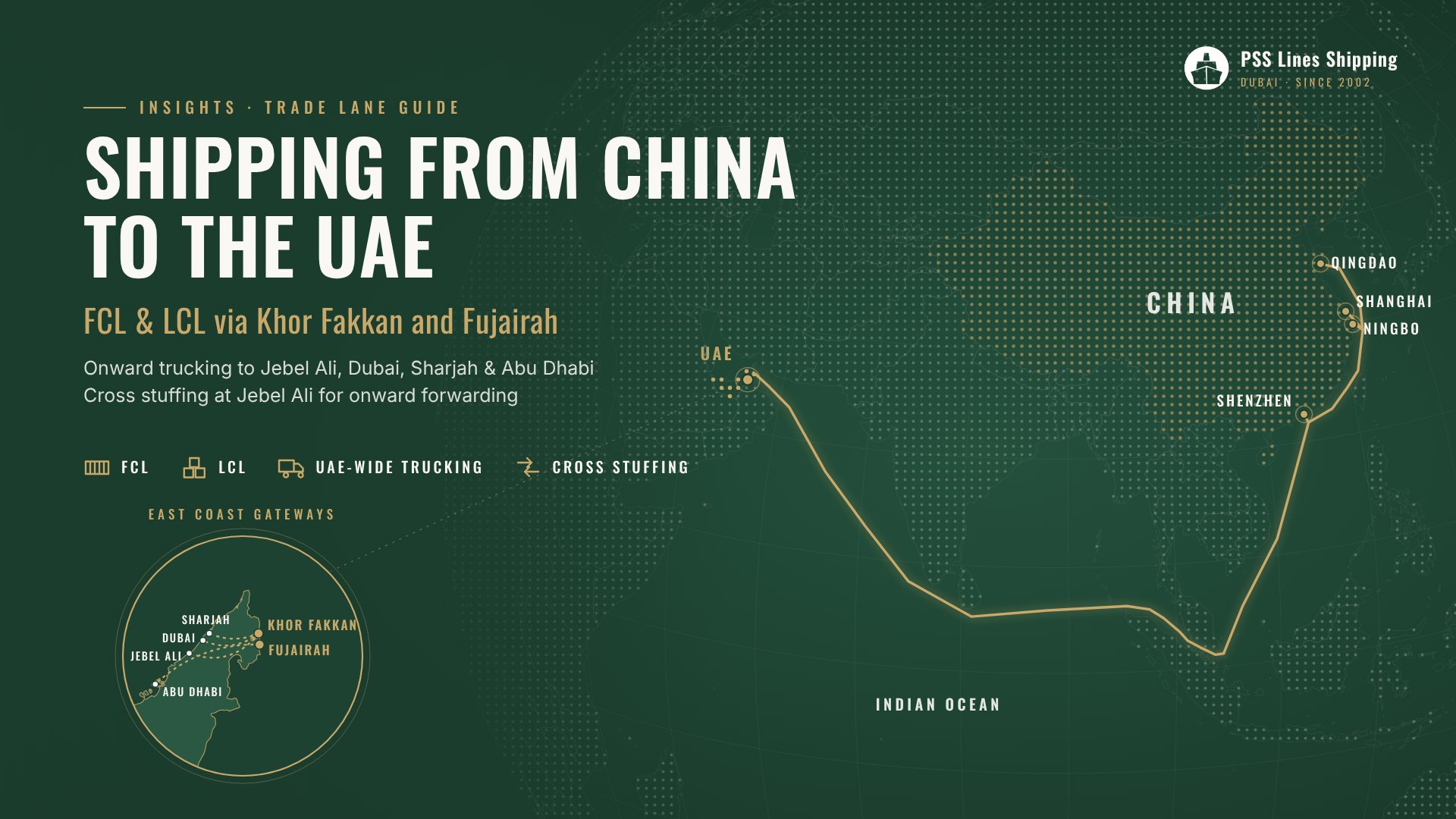
Shipping from China to the UAE supplies a large part of what the Emirates build with, sell and re-export: machinery, solar equipment, electronics, furniture, building materials, vehicles and consumer goods. The lane is as busy as ever. What has changed is the end of the voyage. While commercial transits through the Strait of Hormuz are disrupted, FCL and LCL containers from China to Dubai are largely discharged on the UAE’s east coast, at Khor Fakkan and Fujairah, and then trucked to Jebel Ali, Dubai, Sharjah, Abu Dhabi and the northern emirates.
For a UAE importer buying from China, that turns one movement into two: a long ocean leg across the Indian Ocean and a short but important land leg across the Emirates. This guide covers what that means in practice. It explains which Chinese ports to load at, how to bring together orders from several suppliers, which documents have to be right before the cargo leaves China, and how PSS Lines Shipping takes the container from the east coast to your warehouse or into a new container for onward shipment.

What has changed for cargo from China to the UAE
Khor Fakkan, part of the emirate of Sharjah, and Fujairah both face the Gulf of Oman, outside the Strait of Hormuz. Services from the Far East that used to call at Jebel Ali now discharge UAE cargo at one of these two ports. The UAE authorities have built the onward movement around them: Dubai Customs currently allows containers to travel from Khor Fakkan and Fujairah to Jebel Ali and the Dubai free zones under bonded transit, so they can be cleared in Dubai.
Nothing changes in the purchase itself. The supplier, the invoice and the duty position are the same. What changes is the work after discharge: arranging the truck, choosing where to clear customs, tracking free time, and returning the empty container. A China order that was planned around a Jebel Ali arrival needs these questions settled before the vessel reaches the east coast. Our note on discharging at Khor Fakkan instead of Jebel Ali sets out the contractual consequences.
Buying from China has not become harder. What has changed is the last stretch, and that is where the plan now needs the most attention.
How shipping from China to the UAE works step by step
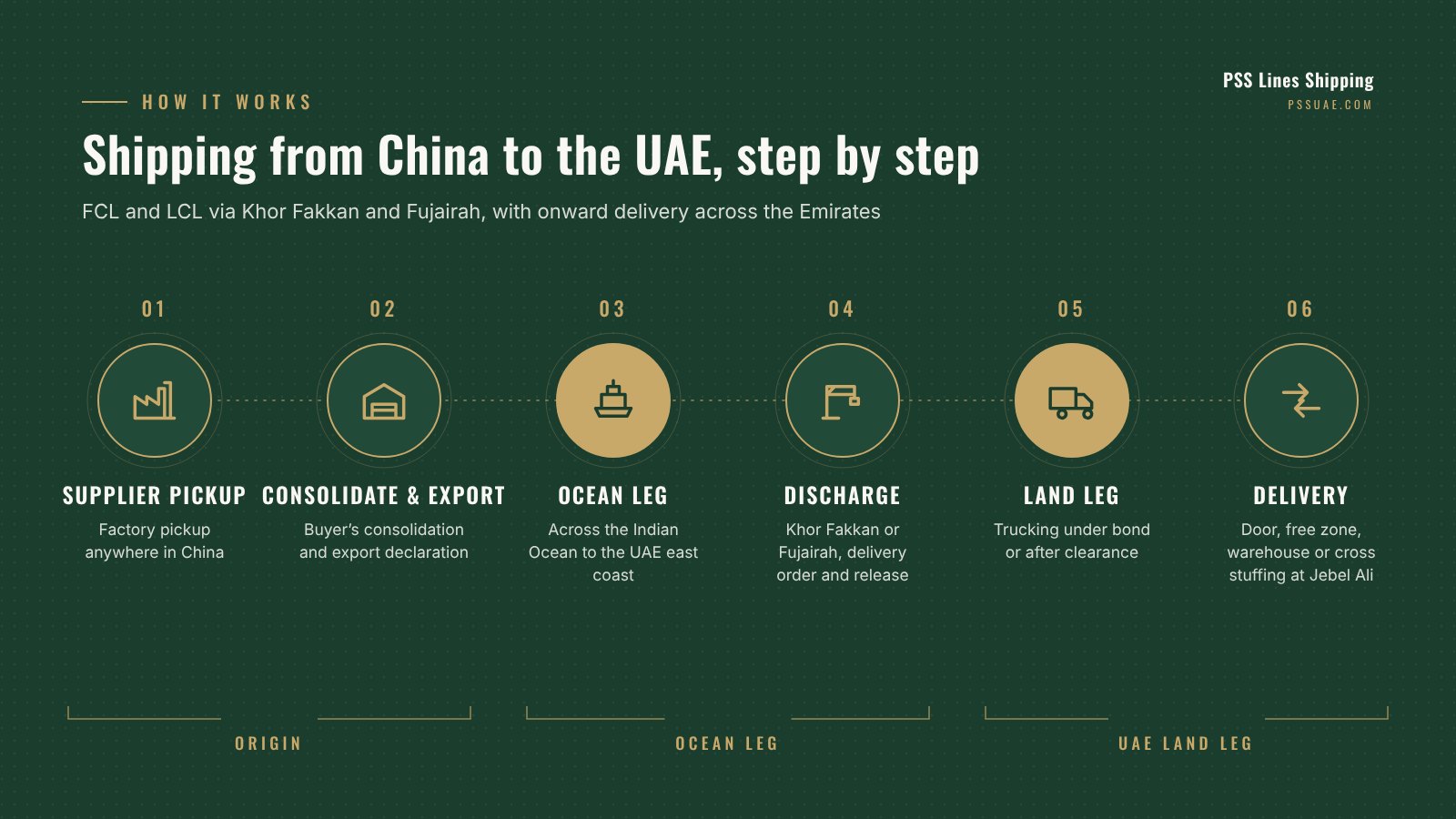
- Cargo ready at the supplier. We confirm the cargo-ready date, the Incoterms and the packing with you and the supplier, and book space for discharge at Khor Fakkan or Fujairah.
- Pickup, consolidation or stuffing. FCL cargo is stuffed at the factory or a nearby yard. LCL and multi-supplier orders go to a consolidation warehouse near the port of loading.
- Chinese export clearance. The export declaration is filed through a licensed customs broker, any required inspection is completed, and the container is gated in before the cut-off.
- Ocean leg to the UAE east coast. The container sails from Shanghai, Ningbo, Shenzhen, Qingdao or another Chinese port to Khor Fakkan or Fujairah.
- Discharge and land leg. The box is released and trucked over the Hajar mountains under customs seal or after clearance to Jebel Ali, a free zone or your premises.
- Delivery, storage or onward shipment. The cargo is delivered, held in a warehouse, or cross stuffed at Jebel Ali for its next destination.
Chinese ports of loading for UAE cargo
China’s coast has several world-class container gateways, and each serves a different manufacturing region. The port should follow the supplier, not the other way round:
| Port of loading | Manufacturing region | Typical UAE cargo |
|---|---|---|
| Shanghai | Shanghai, Jiangsu, Anhui, the Yangtze River Delta | Machinery, electronics, chemicals, automotive parts, solar equipment |
| Ningbo-Zhoushan | Zhejiang, including Yiwu | Consumer goods, hardware, household products, textiles, small-goods consolidations |
| Shenzhen (Yantian, Shekou) | Guangdong and the Pearl River Delta | Electronics, lighting, furniture, telecom equipment, batteries |
| Qingdao | Shandong and northern China | Tyres, steel products, machinery, building materials |
| Other gateways | Tianjin, Xiamen, Guangzhou (Nansha), Dalian | Used where they sit closer to the supplier or offer a better service |
Inland suppliers in Chongqing, Wuhan, Chengdu and other cities reach the coast by Yangtze barge, rail or road.
Cargo from inland China has a longer journey to the port, with its own cut-off that comes well before the vessel’s. We plan the inland leg, the export clearance and the ocean booking as one schedule so the container is not left waiting for a later sailing.
Buying from several suppliers in China: consolidation
Many UAE importers buy from several factories in different cities. Shipping each order as separate LCL means several sets of documents, several deliveries and several sets of charges on arrival. Buyer’s consolidation brings the orders together in one warehouse near the port, checks them against your purchase orders, and loads them into a single container, often as a full container rather than several LCL lots.
- One container and one clearance in the UAE instead of several.
- A check at origin. Cartons are counted and inspected before loading, not after arrival.
- Better use of space. Heavy and light cargo are stowed together so you pay for less empty space.
- Simpler onward handling. The goods can be split again on arrival, or cross stuffed at Jebel Ali for re-export.

FCL or LCL from China to Dubai
We handle both FCL and LCL sea freight from China. The right choice depends on volume, value and how the goods tolerate handling:
| Criterion | LCL | FCL |
|---|---|---|
| Volume | A few pallets up to around 15 cubic metres | 20ft, 40ft or 40ft high cube |
| Charged on | Volume or weight, whichever is greater | Per container |
| Handling | Consolidated in China and deconsolidated in the UAE | Sealed at origin and opened only by customs or the consignee |
| Suits | Samples, trial orders, smaller regular orders | Volume orders, fragile or high-value goods, multi-supplier consolidations |
| On arrival | Delivered loose from the deconsolidation point | Trucked as a full container to your door, a free zone or Jebel Ali |
Container sizes and payloads are listed in our container dimensions reference. As a rule, once a China LCL shipment reaches about half a 20ft container, it is worth pricing a full one as well. We quote both whenever the volume falls in that range.
Trucking from Khor Fakkan and Fujairah to Dubai, Jebel Ali and Abu Dhabi
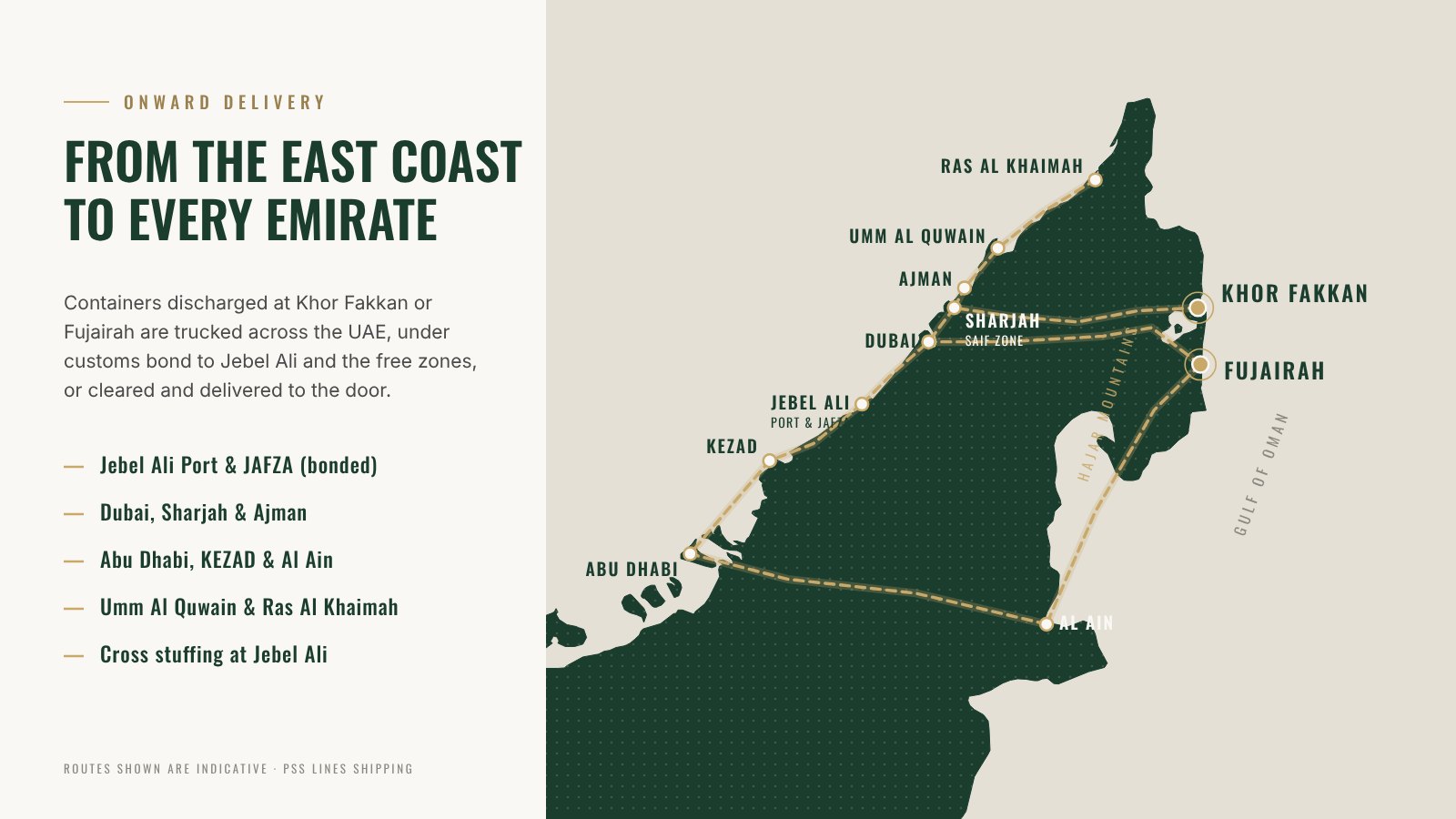
Once the container is on the east coast, we arrange the land leg to any address in the country:
- Jebel Ali Port and JAFZA, under bonded transit for cargo cleared in Dubai, kept in the free zone or re-exported.
- Dubai: Al Quoz, Ras Al Khor, Dubai Investments Park, Al Qusais, Dubai South and Dragon Mart for traders in Chinese goods.
- Sharjah, Ajman and Umm Al Quwain, including the industrial areas, SAIF Zone and Hamriyah Free Zone.
- Abu Dhabi and Al Ain, including Mussafah, ICAD and KEZAD, often best served through Fujairah.
- Ras Al Khaimah and Fujairah, including RAK’s industrial and free zones.
The land leg brings its own costs to watch: container detention while the box is on the road, terminal storage if clearance is slow, and the trip to return the empty to the depot the carrier names. Our detention calculator helps estimate the exposure, and our note on why detention costs are decided before arrival explains how to keep it low.
Cross stuffing at Jebel Ali and re-export
The UAE is one of the main distribution hubs for Chinese goods heading to third markets, and that trade still runs through Jebel Ali. When cargo from China is not staying in the Emirates, we cross stuff it at Jebel Ali, moving it from the arriving container into a new one for the next leg, with a full tally and photographs at every step. It is the practical answer when:
- the cargo is being re-exported, but the arriving container has to be returned;
- a consolidated China load has to be split between buyers in different countries;
- goods need repacking, relabelling or palletising for the next market;
- vehicles, tyres or building materials need restowing for onward shipment.


Our sector pages cover automotive, tyres, FMCG and chemicals in more detail.
Documents for shipping from China to the UAE
Most problems on this lane start at the supplier’s desk. Before the cargo is loaded, check that:
- the commercial invoice shows the true description, HS codes, unit values, currency and Incoterms, and matches the purchase order;
- the packing list gives carton counts and weights that match the invoice and the bill of lading;
- the export declaration has been filed by the supplier or its broker under its export licence;
- the bill of lading names the consignee and notify party correctly and states the port of discharge for the routing;
- the certificate of origin, issued in China by CCPIT or customs, is available, because UAE customs normally expects one;
- product approvals are in place where needed, such as UAE conformity certification for regulated products, type approval for telecom equipment, or registration for food and cosmetics.
When a shipment from China is held in the UAE, the cause is almost always a document that was wrong before loading.
Batteries, dangerous goods and project cargo from China
A lot of what the UAE buys from China is classed as dangerous goods: lithium batteries, power banks, electric bikes and scooters, energy-storage systems, paints and chemicals. These move under the IMDG Code with a dangerous goods declaration, a safety data sheet and correct UN packaging and labelling. Carriers currently confirm acceptance of hazardous, refrigerated and out-of-gauge cargo into the UAE case by case, by class, line and discharge port, so we check it for your cargo before booking. See our dangerous goods reference. Heavy machinery, steel structures and plant equipment are handled under our project forwarding service.
Planning around China’s calendar
Chinese factory schedules shape this lane more than the ocean does. Factories close for Chinese New Year and slow down around Golden Week, and the weeks before both bring a rush of cargo and pressure on space. Importers who book early, confirm cargo-ready dates in writing and allow for the UAE land leg avoid most of the disruption. We flag these periods in advance so your orders are not caught by them.
What decides the cost of shipping from China to the UAE
- Supplier location, whether coastal or inland.
- Volume and weight, as LCL chargeable volume or the number of containers.
- Type of goods, whether general, hazardous, oversized or temperature-controlled.
- Incoterms: EXW, FOB, CFR or CIF change who pays for and controls each leg.
- Discharge port and final address, which decide the land leg.
- Consolidation, clearance and handling at both ends.
- Market conditions on the lane at the time of booking.
We quote against the routing actually available when you book, and we tell you which costs are fixed and which depend on events after discharge.
Shipping rates from China to the UAE
We are preparing weekly rate pages for the main China–UAE lanes. Until they go live, ask us for a current quotation for your cargo.
| Lane | Equipment | Weekly rate |
|---|---|---|
| Shanghai → Jebel Ali / Dubai | 20ft / 40ft / 40HC FCL | Coming soon |
| Ningbo → Jebel Ali / Dubai | 20ft / 40ft / 40HC FCL | Coming soon |
| Shenzhen → Jebel Ali / Dubai | 20ft / 40ft / 40HC FCL | Coming soon |
| Qingdao → Jebel Ali / Dubai | 20ft / 40ft / 40HC FCL | Coming soon |
| China → Khor Fakkan / Fujairah | 20ft / 40ft FCL | Coming soon |
| China → Dubai | LCL per cubic metre | Coming soon |
Weekly rate updates for these lanes are coming soon. Request a current quote in the meantime.
How PSS Lines Shipping helps on the China–UAE lane
Operating from Dubai since 2002, we handle the China–UAE shipment as one movement under one point of contact:
- FCL and LCL from all main Chinese ports, with pickup from suppliers across China.
- Buyer’s consolidation of orders from several suppliers into one container.
- Routing through Khor Fakkan or Fujairah, matched to the cargo and the destination.
- Customs clearance on arrival or in Dubai, including bonded transit to Jebel Ali and the free zones.
- Trucking to every emirate, including Dubai, Jebel Ali, Sharjah, Abu Dhabi, Ajman, Ras Al Khaimah, Umm Al Quwain, Al Ain and Fujairah.
- Cross stuffing at Jebel Ali for re-export and onward forwarding.
- Warehousing, cargo insurance and air freight for urgent parts of an order.
Frequently asked questions
Get a routing and a rate from China
Tell us where your suppliers are, what you are buying and where it needs to arrive. We will come back with a realistic routing through Khor Fakkan or Fujairah, a working rate and a clear explanation of where the risk sits on the way.
Shipping from China to the UAE?
Send us the details and our Dubai operations desk will come back with a routing and a working rate.
Published 24 October 2026 · All insights →