
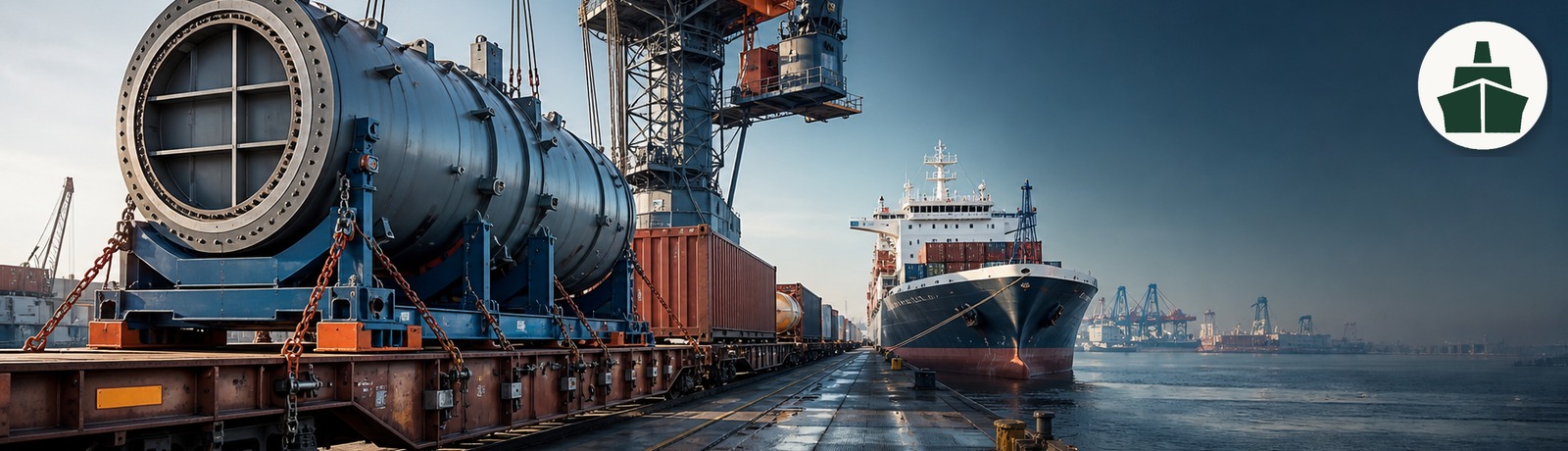
Germany exports to the Gulf differently from most European origins. The cargo is heavier, more engineered and more often oversized — machine tools, plant equipment, automotive components, chemical product, measuring and control instruments. And it does not originate at the coast. The overwhelming majority of German containers destined for the UAE begin several hundred kilometres inland, at a rail terminal or an inland port, and reach Hamburg or Bremerhaven as the last step of a domestic journey rather than the first step of an international one.
That single fact shapes everything about the lane. Get the inland leg right and the ocean leg is straightforward. Get it wrong and no amount of freight rate negotiation recovers the difference.
We have worked the Germany–UAE lane for over ten years through established partners in Germany who handle the origin side directly, and this note sets out how we approach it.
For the ocean leg, our sea transport service covers FCL and LCL. Where the cargo or timing favours an overland corridor, our Europe–Middle East road freight service handles full truck loads and groupage.
The two seaports
Hamburg is the larger of the two and the more connected inland, with an exceptional rail network reaching deep into central and southern Germany, Austria, the Czech Republic and Poland. For UAE-bound cargo it offers the widest choice of services and the best chance of an alternative when a sailing is missed. Its one structural characteristic worth planning around is the Elbe approach: the port sits well up the river, and vessel schedules are more sensitive to tidal and pilotage constraints than at a coastal port.
Bremerhaven sits at the mouth of the Weser with direct sea access and no comparable river transit. It is the stronger option for very large vessels and for automotive cargo, where its ro-ro and vehicle-handling capability is among the best in Europe. For shippers in the north-west and for heavy or awkward pieces, Bremerhaven frequently produces a cleaner routing than Hamburg even where the rail distance is similar.
In practice the choice between them is usually decided by which one has the better service to your chosen UAE discharge port in the week you need to move, and by which inland terminal serves your origin more efficiently.
The inland terminals — where German cargo actually starts
Germany has the densest inland terminal network in Europe, combining Rhine barge, dedicated rail shuttles and inland container depots. These are the ones that matter most for Gulf-bound cargo:
| Terminal | Serves | Why it matters for UAE cargo |
|---|---|---|
| Duisburg (DEDUI) | Ruhr, North Rhine-Westphalia | The largest inland port in the world and the anchor of the Rhine corridor. Barge and rail to both seaports, and the default consolidation point for the western industrial belt. |
| Frankfurt am Main (DEFRA) | Hesse, Rhine-Main | Central rail hub with strong onward connections; the natural gateway for the chemical, pharmaceutical and instrumentation cluster around Frankfurt and Darmstadt. |
| Mannheim / Ludwigshafen | Baden-Württemberg, Rhineland-Palatinate | The chemical heartland. Substantial hazardous and bulk-liquid-adjacent flows; barge access on the Rhine. |
| Cologne / Neuss | Lower Rhine | High-frequency barge shuttles to both seaports; useful for steady, repeatable volume. |
| Stuttgart | Baden-Württemberg | Automotive and machine tools. Heavy, dense cargo where weight limits bite before volume does. |
| Nuremberg | Northern Bavaria | Strong rail links north; serves the Franconian engineering base. |
| Munich (Riem) | Southern Bavaria | The southern rail gateway; also the practical consolidation point for cargo coming up from Austria. |
| Karlsruhe | Upper Rhine | Rhine barge and rail; convenient for the south-west and for cargo staged from Alsace. |
| Hannover | Lower Saxony | Short rail run to Bremerhaven and Hamburg; efficient for mid-volume industrial shippers. |
| Leipzig | Saxony, eastern Germany | The eastern hub, serving a manufacturing base that would otherwise face a long road haul. |
Two things are worth understanding about this network. First, barge and rail behave differently. Rail is faster and more schedule-reliable; barge is cheaper per unit and better for heavy cargo, but Rhine water levels can constrain loading in a dry summer, and that risk is real rather than theoretical. Second, the terminal you use changes your cut-off. An inland terminal three days from the quay means your effective closing date is three days earlier than the vessel cut-off, and every document has to be right by then rather than by sailing.
Where the cargo discharges in the UAE
Jebel Ali is the primary gateway for Dubai and the northern emirates, and the right discharge point where cargo needs consolidating, splitting between consignees or preparing for onward re-export. It is where our cross-stuffing operation sits.
Abu Dhabi, through Khalifa Port, is the correct destination for cargo going to the emirate itself, to KIZAD-based industry, and for a great deal of energy-sector equipment — which, on a German lane, is a significant share of the volume. Routing that cargo through Jebel Ali and trucking it south is common and frequently unnecessary.
Fujairah, on the Gulf of Oman, sits outside the Strait and has become a serious option where routing reliability outweighs the shortest paper transit.
What we do on this lane
- Plan from the factory gate, not the quay. The inland terminal, the mode and the cut-off are decided together with the ocean booking, because on a German shipment they determine each other.
- Engineer the out-of-gauge pieces properly. German plant and machine tools regularly exceed standard dimensions or point-load limits. Flat racks, open tops, bolster arrangements, lashing calculations and, where needed, route surveys for the inland leg. Our project forwarding covers the heavier end of this.
- Handle hazardous cargo to the letter. The German chemical sector generates substantial IMDG volume. Classification, declarations, segregation and the full documentation set, checked before the box reaches the terminal.
- Watch the weight, not just the volume. German cargo hits payload limits long before it fills the box. Road weight limits on the inland leg, VGM accuracy and axle-load compliance all need to be right, and getting this wrong is expensive at the terminal gate.
- Consolidate across suppliers and across borders. German shipments frequently combine with cargo from Austria, Switzerland, the Czech Republic or the Netherlands. Consolidation can happen at an inland terminal, at the seaport, or at Jebel Ali — whichever produces the better outcome.
- Manage free time from the point of booking. Detention and demurrage exposure is set well before arrival.
Ten years on the lane
What a decade on Germany–UAE has actually produced is three things worth naming.
Partners in Germany who do the work themselves. Collection, inland movement, export clearance and terminal delivery handled directly rather than subcontracted onward. When a rail slot moves or a vessel omits a call, we hear it from someone with hands on the cargo.
Working relationships with the lines serving this trade. The useful part of that is not rate. It is equipment availability when boxes are short, a straight answer about whether a booking will genuinely load, and someone who will engage on a rolled container or an out-of-gauge acceptance. That is earned through years of volume.
Knowing the failure modes. Rhine low water and what it does to barge planning. The gap between a quoted inland transit and a realistic one in week 51. Which terminals handle a late correction gracefully. Most of the value on this lane is in avoiding the predictable problems.
Frequently asked questions
It is usually decided by two things: which port has the better service to your UAE discharge port in the week you need to sail, and which inland terminal serves your origin more efficiently. As a general guide, Hamburg has the deeper inland rail reach and the wider choice of services, which gives you more options when something goes wrong. Bremerhaven has direct sea access without the Elbe river transit and is particularly strong for automotive and for very large vessels. For heavy or oversized pieces from the north-west, Bremerhaven often produces the cleaner routing. We compare both against your actual origin rather than defaulting to one.
By rail or Rhine barge from one of the inland terminals, or by road for shorter distances and urgent movements. Germany has the densest inland terminal network in Europe — Duisburg, Frankfurt, Mannheim, Cologne, Stuttgart, Nuremberg, Munich, Karlsruhe, Hannover and Leipzig among the main ones. Rail is faster and more schedule-reliable; barge is cheaper per unit and better suited to heavy cargo, though Rhine water levels can constrain loading in a dry summer. The important practical point is that your effective cut-off is the inland terminal’s, not the vessel’s — which can be several days earlier. We plan the inland leg and the ocean booking together for exactly that reason.
Yes — it is a large share of what moves on this lane. German machine tools, plant sections and industrial equipment regularly exceed standard container dimensions or concentrate weight beyond a flat floor’s tolerance. We handle flat rack and open top loading, bolster arrangements, engineered lashing and securing calculations, and route surveys where the inland leg needs one. Our project forwarding service covers heavy lift and break bulk in more detail. One current caveat worth raising early: carrier acceptance for out-of-gauge into the UAE is more restricted than usual at present and varies by line and discharge port, so an OOG booking needs confirming per shipment rather than assumed.
Yes. The German chemical and pharmaceutical sector generates substantial IMDG volume on this lane and it is routine work for us. We prepare and verify the dangerous goods declaration, safety data sheet and container packing certificate, confirm segregation requirements, and make sure the documentation is correct before the container reaches the terminal — a rejected declaration at the gate costs a day and a re-booking, and the cargo sits accruing charges meanwhile. Carrier acceptance for hazardous cargo into the UAE is currently restricted and varies by class, by line and by discharge port, so we confirm the position for your specific classification rather than working from a general assumption. Our dangerous goods reference sets out the classes and the paperwork each attracts.
Jebel Ali for Dubai and the northern emirates, and for anything that needs consolidating, splitting or re-exporting. Khalifa Port for cargo destined for Abu Dhabi itself, for KIZAD industry and for much energy-sector equipment — which on a German lane is a meaningful share of volume, and which is often routed through Jebel Ali and trucked south unnecessarily. Fujairah sits outside the Strait on the Gulf of Oman and is a genuine option where routing reliability matters more than the shortest transit on paper. The decision follows the final delivery address and the urgency, not habit.
Carefully, because German cargo tends to reach its payload limit long before it fills the box. Three things need to line up: the container’s maximum payload, the road and rail weight limits on the inland leg, and an accurate Verified Gross Mass declaration. Axle-load compliance on the inland movement is a genuine constraint in Germany and not something to discover at a weighbridge. Where cargo is dense — machine tools, castings, steel components — the right answer is often more 20ft units rather than fewer 40ft, which looks counter-intuitive on a rate sheet and is cheaper in practice.
Yes, and on this lane it is usually the sensible structure. We can collect from the supplier’s premises anywhere in Germany, handle the inland movement and export clearance, arrange the ocean leg, clear the cargo in the UAE and deliver to the final address. Because the inland leg and the cut-off are so tightly linked on German shipments, controlling both ends removes most of the coordination risk. If you already have inland arrangements in place we are equally happy to quote from the terminal or the seaport — tell us what you have and we will price the part you need.
Getting a realistic answer
A useful recommendation on this lane needs four things: where the goods are made, what they are, how much they weigh, and where they need to end up. Give us those and we will come back with a comparison of the realistic routings — inland mode, seaport, service and discharge port — rather than a single number, and we will tell you plainly where the risk sits.
Send us the shipment details and we will work it through.
Published 26 August 2026 · updated 30 August 2026 · All insights →