
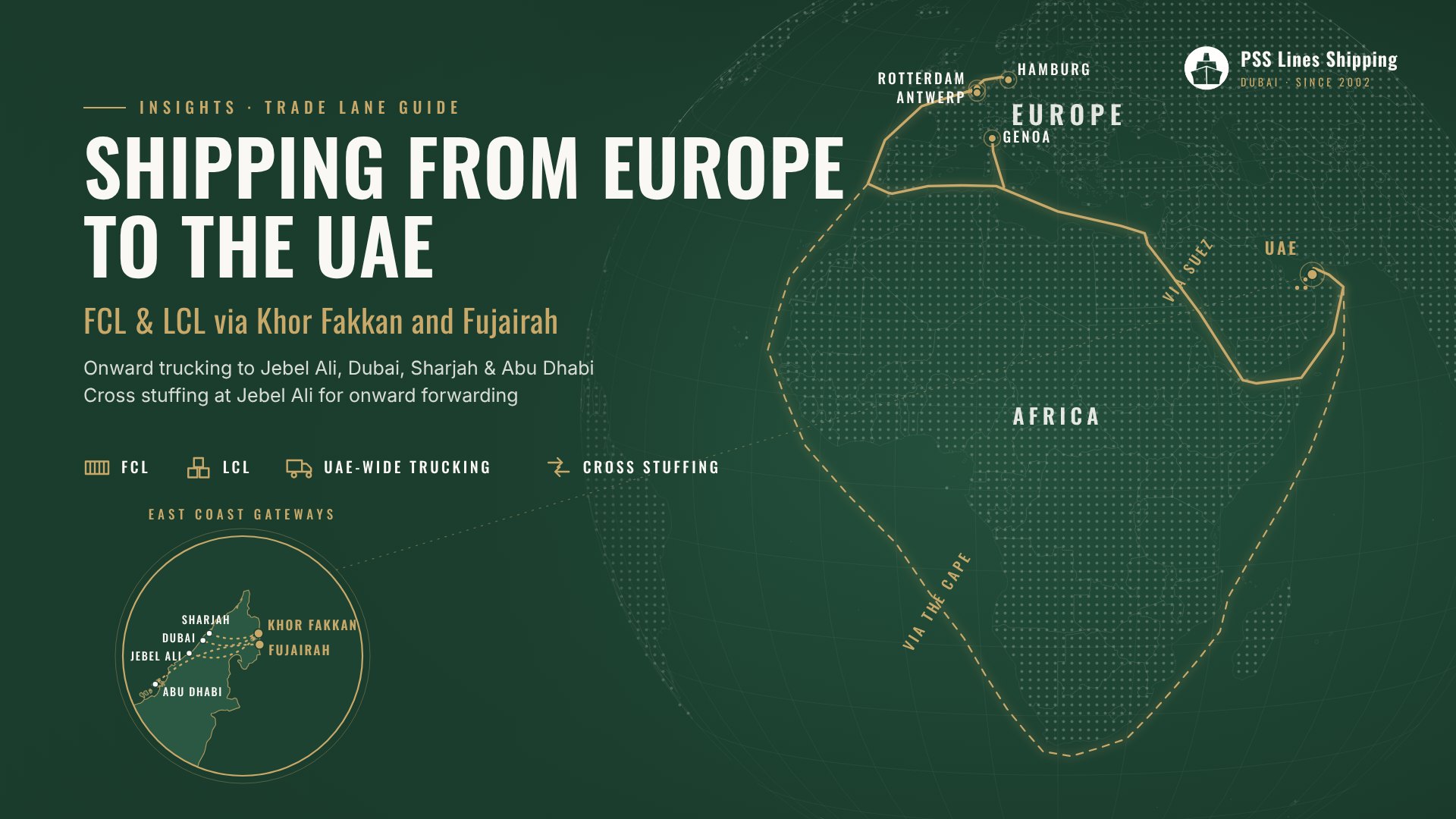
Shipping from Europe to the UAE covers some of the most valuable cargo the Emirates import: machinery and industrial equipment, vehicles and parts, pharmaceuticals, chemicals, luxury goods, food and building products. European suppliers are still shipping every week. What has changed is the end of the voyage. While commercial transits through the Strait of Hormuz are disrupted, most FCL and LCL cargo from Europe to Dubai is discharged on the UAE’s east coast, at Khor Fakkan and Fujairah, and then trucked across the country to Jebel Ali, Dubai, Sharjah, Abu Dhabi and the northern emirates.
This guide covers the whole lane from a European factory to a UAE consignee. It explains which European ports to use, how the routing to the east coast works, which documents have to be ready before the container leaves the EU or the UK, and how PSS Lines Shipping handles the land leg, customs clearance and cross stuffing at Jebel Ali. For country detail, see our lane guides for Germany, the Netherlands and Italy.
What has changed on the Europe–UAE lane
Khor Fakkan, part of the emirate of Sharjah, and Fujairah both face the Gulf of Oman, outside the Strait of Hormuz. Services from Northern Europe and the Mediterranean that used to call at Jebel Ali now discharge UAE cargo at one of these two ports. Depending on the service, vessels reach them either through the Suez Canal and the Red Sea or around the Cape of Good Hope. The routing depends on the carrier’s network and is confirmed at booking.
On arrival, Dubai Customs currently allows containers to move from Khor Fakkan and Fujairah to Jebel Ali and the Dubai free zones under bonded transit, so they can be cleared in Dubai. The commercial deal is unchanged. The work after discharge is different: the land leg, the place of clearance, the start of free time and the return of the empty. Our note on discharging at Khor Fakkan instead of Jebel Ali covers what this means under your contract of carriage and your Incoterms.
A European shipment that was priced to Jebel Ali and now discharges on the east coast is a different movement. It needs planning as one.
How shipping from Europe to the UAE works
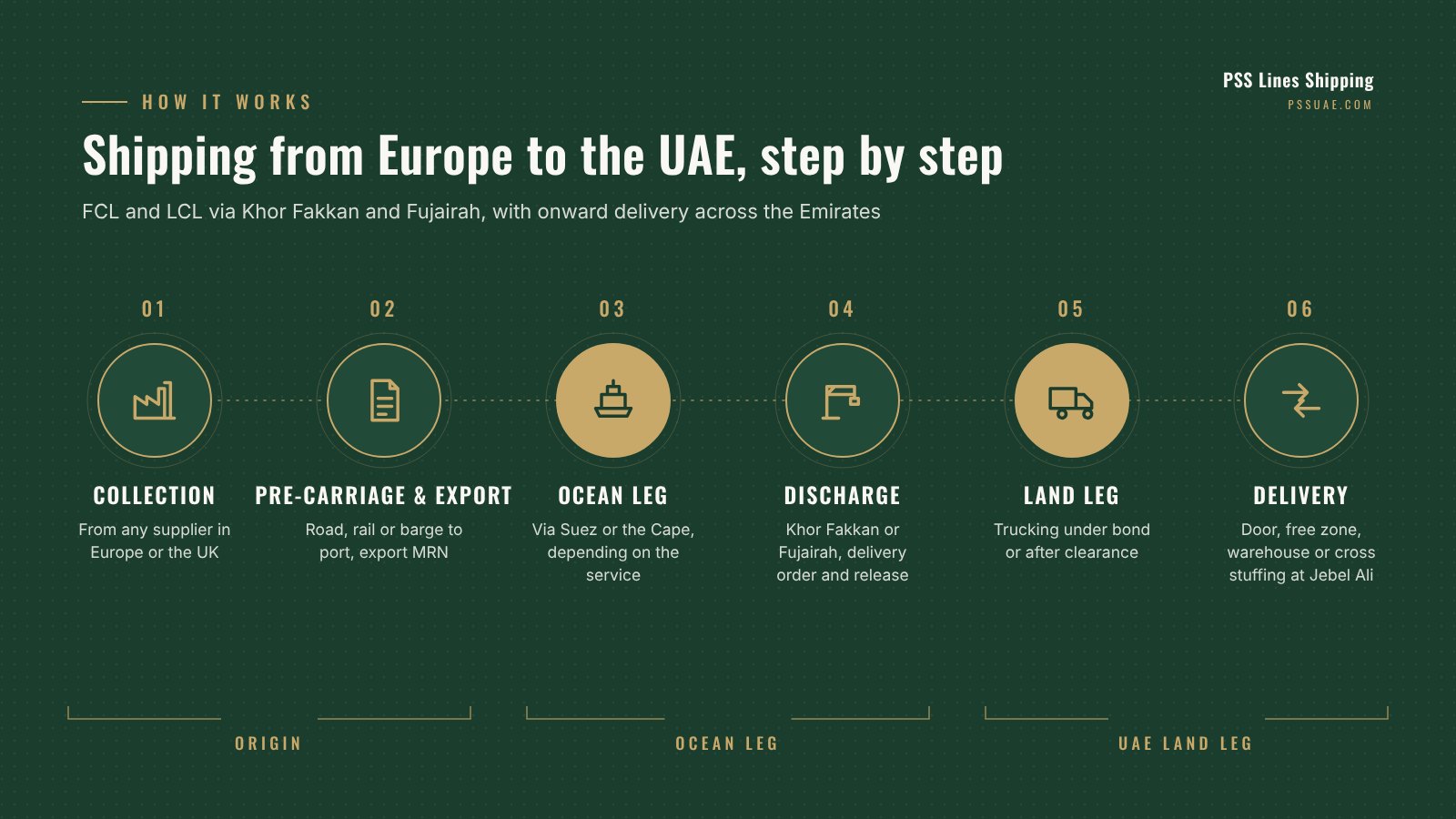
- Collection from the supplier. We collect from the factory or warehouse anywhere in Europe, or receive the cargo at an inland terminal, a consolidation warehouse or the seaport.
- Pre-carriage to the seaport. Cargo travels by truck, rail or Rhine barge to Rotterdam, Antwerp, Hamburg or another gateway, and the inland cut-off is planned together with the vessel’s.
- EU or UK export declaration. The goods are declared for export and receive an MRN. Export-control checks are completed where the goods require them.
- Ocean leg to the UAE east coast. The container sails, via Suez or the Cape depending on the service, to Khor Fakkan or Fujairah.
- Discharge and land leg. The box is released and trucked over the Hajar mountains, either under customs seal or after clearance, to Jebel Ali, a free zone or the consignee.
- Clearance, delivery or onward forwarding. The cargo is cleared and delivered, stored, or cross stuffed at Jebel Ali for its next destination.
European ports of loading for UAE cargo
Europe has two main port ranges for UAE cargo. The North Range, from Le Havre to Hamburg, handles most volume from Germany, the Benelux, Scandinavia and Central Europe. The Mediterranean ports serve Southern Europe:
| Port | Main hinterland | Why use it for UAE cargo |
|---|---|---|
| Rotterdam | Netherlands, Germany (Rhine), Belgium, Central Europe | Europe’s largest port, with the widest service choice and dense barge and rail links inland |
| Antwerp-Bruges | Belgium, France, Germany, Luxembourg | Very strong in chemicals, project cargo and break bulk, and a natural port for Belgian and northern French industry |
| Hamburg | Germany, Austria, Czechia, Poland, Scandinavia | Rail gateway to Central and Eastern Europe and to German industry |
| Bremerhaven | Northern and western Germany | Deep-water access, strong for vehicles, ro-ro and heavy cargo |
| Mediterranean ports | Italy, Spain, France, Greece, Slovenia | Genoa, La Spezia, Valencia, Barcelona, Piraeus and Koper serve Southern European suppliers |
| UK and Baltic ports | United Kingdom, Poland, the Baltic states | Felixstowe, London Gateway and Southampton for UK exporters, and Gdańsk for Poland and the Baltic |
The port follows the supplier’s location, the commodity and the service available in the week you need to ship.
The European inland leg often shapes the shipment more than the ocean leg. An inland terminal several days from the quay brings the effective cut-off forward by the same number of days, and every document has to be ready by then. We plan the inland movement, the export declaration and the ocean booking as one schedule.
FCL or LCL from Europe to Dubai
We offer both FCL and LCL sea freight from Europe to the UAE:
| Criterion | LCL (groupage by sea) | FCL |
|---|---|---|
| Volume | From a single pallet up to around 15 cubic metres | 20ft, 40ft, 40ft high cube or special equipment |
| Charged on | Volume or weight, whichever is greater | Per container |
| Handling | Consolidated at a European CFS and deconsolidated in the UAE | Sealed at origin and opened only by customs or the consignee |
| Suits | Spare parts, samples, smaller orders, retail replenishment | Machinery, volume orders, heavy or high-value goods |
| On arrival | Delivered loose from the deconsolidation point | Trucked as a full container to the door, a free zone or Jebel Ali |
European cargo is often dense, so it reaches the container’s weight limit before it fills the space. For machine tools, castings or steel, several 20ft containers can work out better than fewer 40ft ones. Our container dimensions reference lists payloads and internal sizes. For some cargo, road freight from Europe to the Middle East is a further option worth comparing.
From Khor Fakkan and Fujairah to Jebel Ali, Dubai and Abu Dhabi
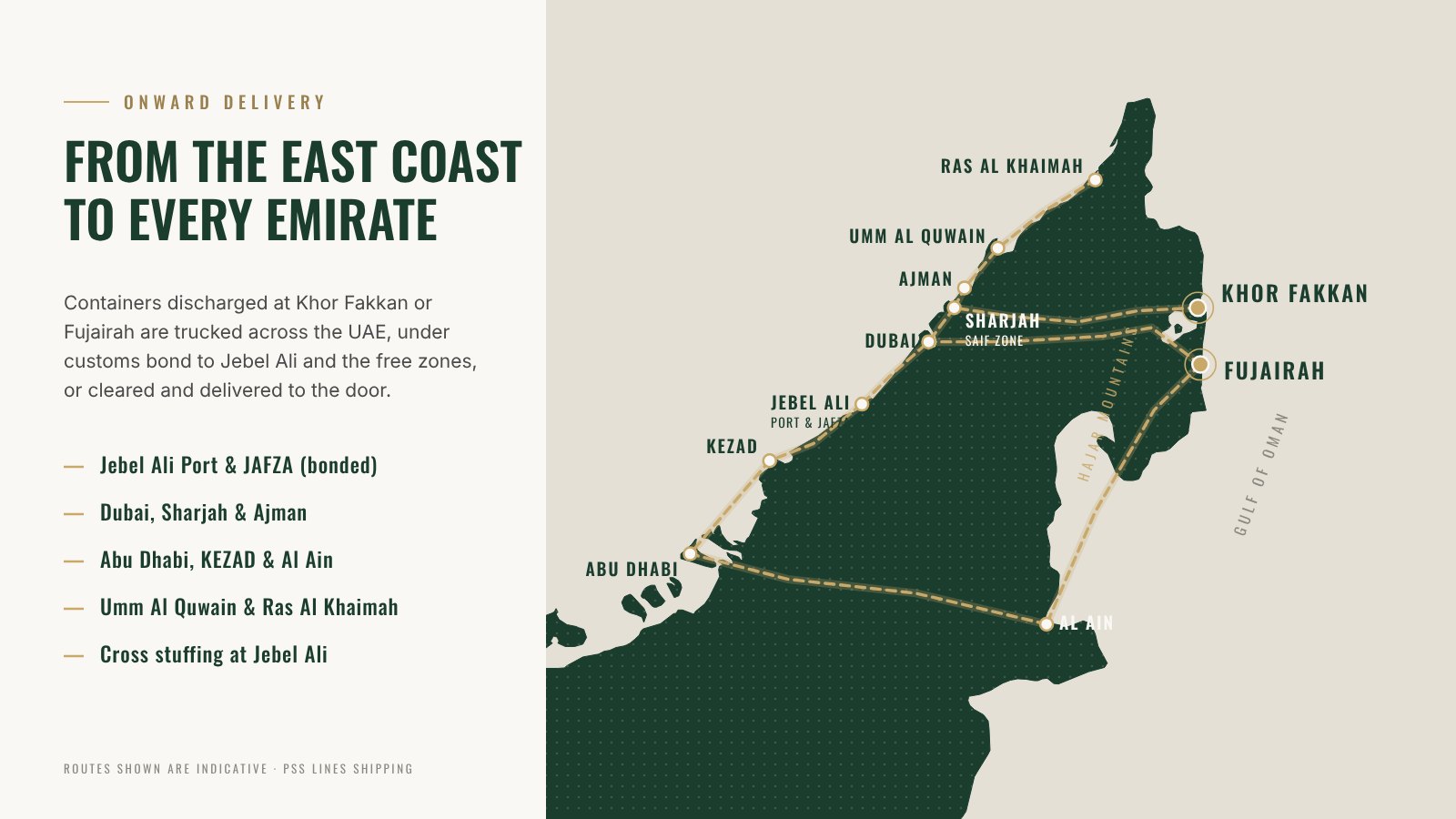
After discharge we take the container across the country to wherever it needs to go:
- Jebel Ali Port and JAFZA, under bonded transit, for cargo cleared in Dubai, kept in the free zone or re-exported.
- Dubai: Dubai Investments Park, Al Quoz, Ras Al Khor, Dubai South, Dubai Industrial City and the rest of the city.
- Abu Dhabi and Al Ain: Mussafah, ICAD, KEZAD and Khalifa Industrial Zone, a major destination for European energy and industrial equipment, often best reached from Fujairah.
- Sharjah, Ajman and Umm Al Quwain, including SAIF Zone, Hamriyah and the industrial areas.
- Ras Al Khaimah and Fujairah, including RAK’s industrial and free zones.
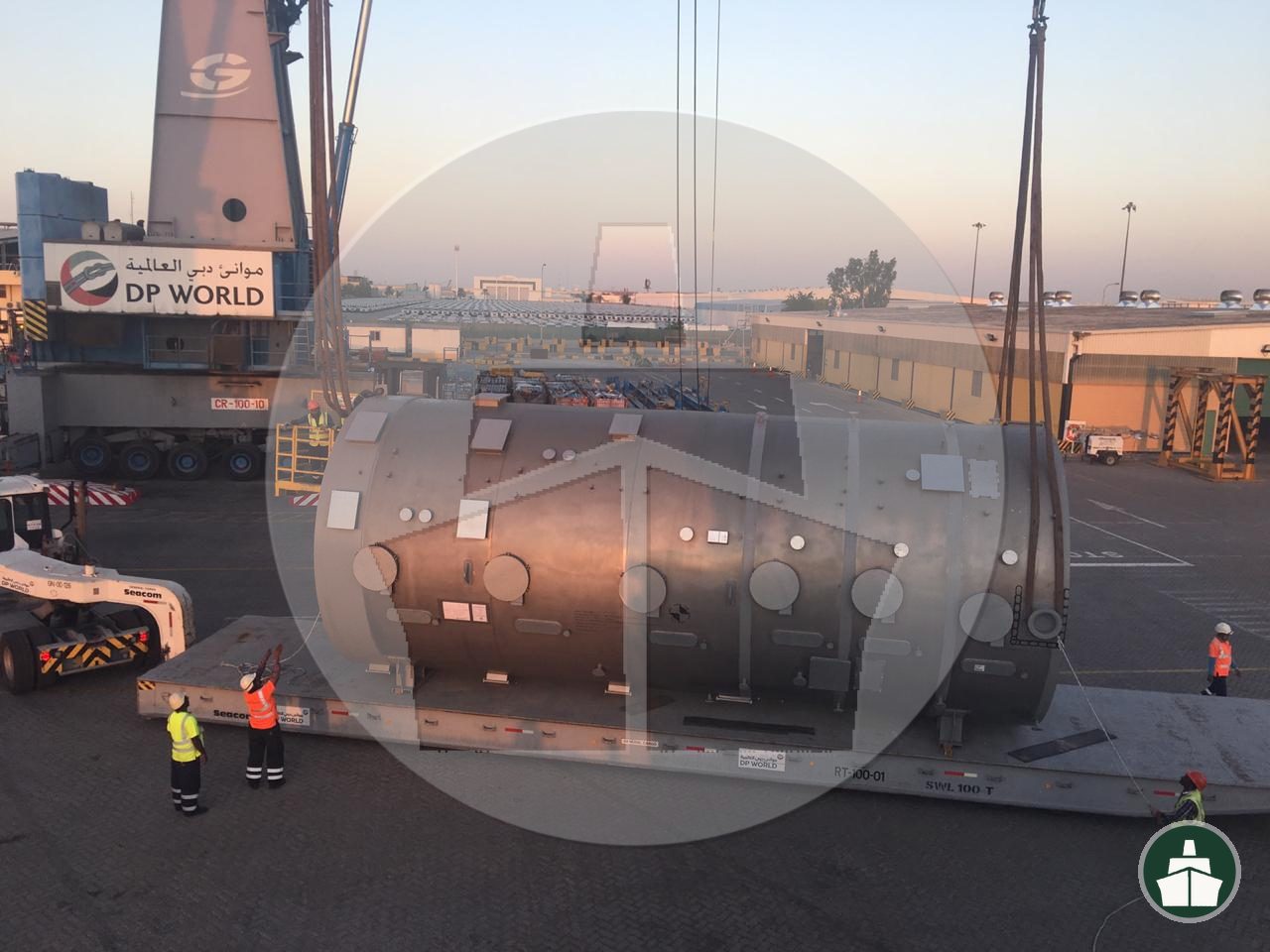
Heavy and out-of-gauge European cargo needs particular care on the land leg. Mountain roads, axle limits and permits for oversized loads all have to be planned before the vessel arrives. Our project forwarding team plans flat racks, open tops and abnormal-load trucking, and our detention calculator helps you keep the land leg inside free time.
Cross stuffing at Jebel Ali for onward forwarding
Much of the European cargo landed in the UAE continues to a buyer in another market. When the arriving container must be returned, a load needs splitting, or goods need repacking for their next destination, we cross stuff it at Jebel Ali. The cargo is transferred into a new container under a full tally, with photographic records at every stage.
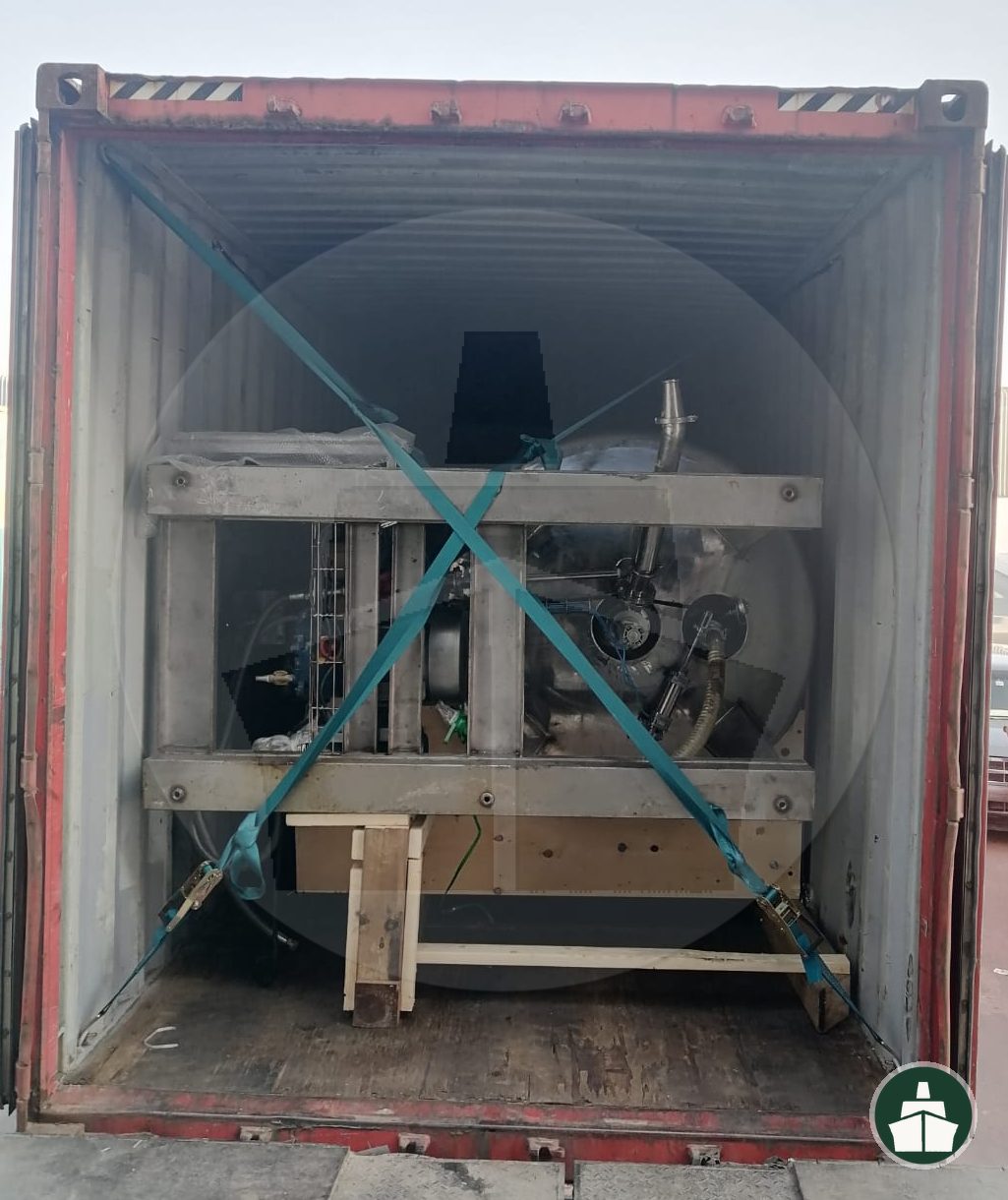
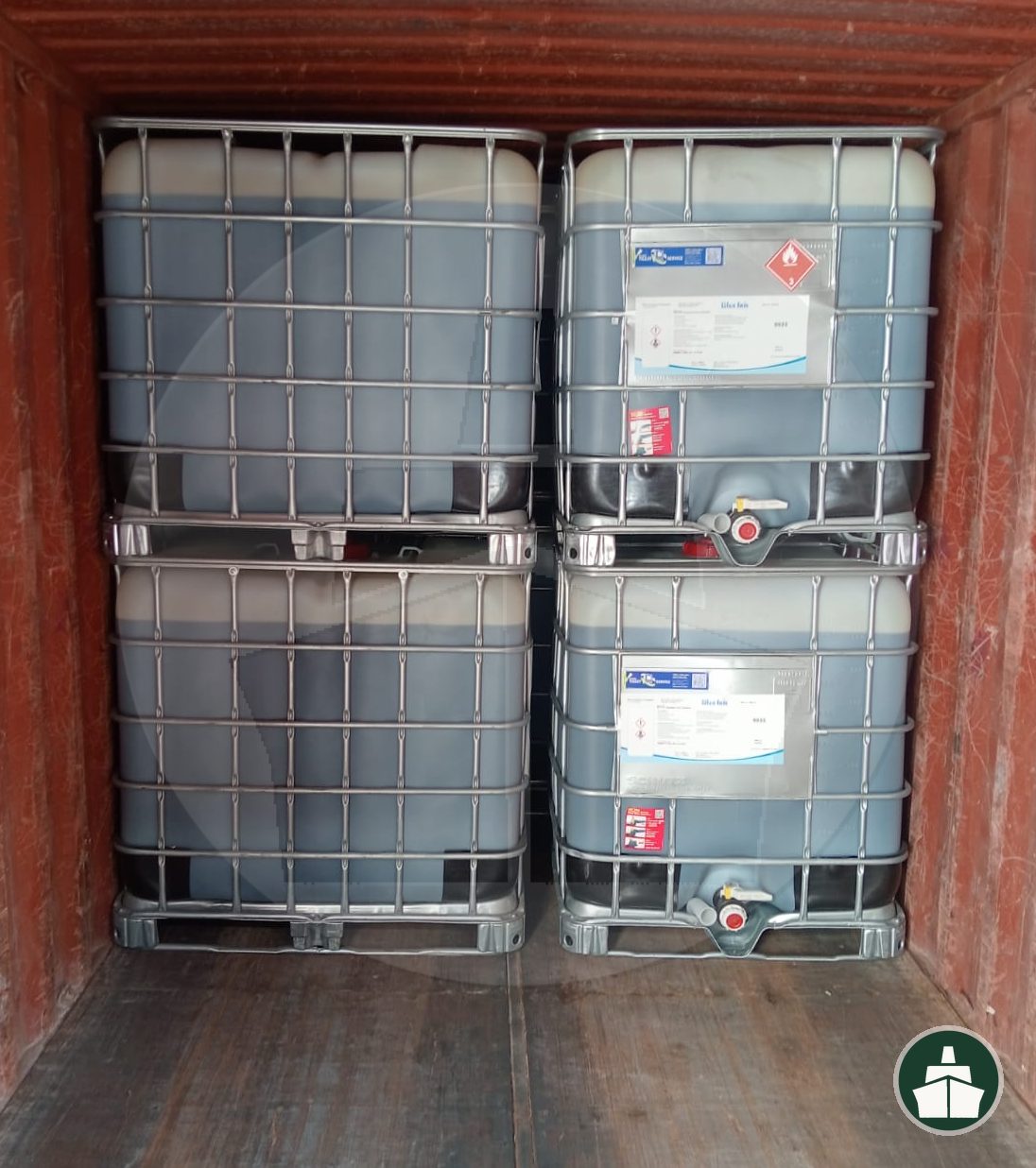
We handle European oil and gas equipment, chemicals, automotive and food and beverage cargo every week.
Documents for shipping from Europe to the UAE
- Commercial invoice, with the full description, HS codes, values, currency and Incoterms.
- Packing list, with weights and dimensions that match the invoice and the bill of lading.
- Export declaration with its MRN, filed in the EU member state or the UK of export.
- Export licence where the goods are dual-use or otherwise controlled. This is common with machinery, electronics and chemicals, and it must be checked before booking.
- Bill of lading, with the consignee, notify party and port of discharge correct for the routing.
- Certificate of origin, normally issued by the chamber of commerce in the country of export. There is no EU–UAE free trade agreement in force yet, so standard UAE duty applies.
- Product approvals where needed: UAE conformity certification for regulated products, registration for food, cosmetics and pharmaceuticals, and a safety data sheet for chemicals.
On European cargo the paperwork deadline is the inland cut-off, not the vessel’s. Every document has to be right by then.
Dangerous goods, temperature-controlled and heavy cargo
European chemical and pharmaceutical exporters ship a lot of IMDG cargo to the UAE. We prepare and check the dangerous goods declaration, safety data sheet and container packing certificate before the container reaches the terminal. Carriers currently confirm acceptance of hazardous, refrigerated and out-of-gauge cargo into the UAE case by case, by class, line and discharge port, so we check it for your shipment rather than assume it. Our dangerous goods reference sets out the classes and what each needs.
What decides the cost of shipping from Europe to the UAE
- Collection point and the inland mode to the seaport.
- Port of loading: North Range or Mediterranean.
- Volume, weight and equipment: LCL volume, container count, or special equipment.
- Type of goods: general, hazardous, temperature-controlled or out-of-gauge.
- Incoterms, and where risk and cost transfer between seller and buyer.
- Discharge port and final address, which decide the land leg in the UAE.
- Clearance, storage and handling at destination, and the empty return.
We quote against the routing actually available when you book, and we explain which costs are fixed and which depend on events after discharge.
Shipping rates from Europe to the UAE
We are preparing weekly rate pages for the main Europe–UAE lanes. Until they go live, ask us for a current quotation for your cargo.
| Lane | Equipment | Weekly rate |
|---|---|---|
| Rotterdam → Jebel Ali / Dubai | 20ft / 40ft FCL | Coming soon |
| Antwerp → Jebel Ali / Dubai | 20ft / 40ft FCL | Coming soon |
| Hamburg → Jebel Ali / Dubai | 20ft / 40ft FCL | Coming soon |
| Genoa → Jebel Ali / Dubai | 20ft / 40ft FCL | Coming soon |
| Europe → Khor Fakkan / Fujairah | 20ft / 40ft FCL | Coming soon |
| Europe → Dubai | LCL per cubic metre | Coming soon |
Weekly rate updates for these lanes are coming soon. Request a current quote in the meantime.
How PSS Lines Shipping helps on the Europe–UAE lane
PSS Lines Shipping has operated from Dubai since 2002 and works the Europe–UAE lane through established partners across Europe. Each shipment is handled as one movement:
- Collection anywhere in Europe and the UK, with pre-carriage by road, rail or barge.
- FCL and LCL from the North Range, the Mediterranean, the UK and the Baltic.
- Routing through Khor Fakkan or Fujairah, chosen for the cargo and the destination.
- Customs clearance on arrival or in Dubai, including bonded transit to Jebel Ali and the free zones.
- Trucking to every emirate, including Dubai, Jebel Ali, Sharjah, Abu Dhabi, Al Ain, Ajman, Umm Al Quwain, Ras Al Khaimah and Fujairah.
- Cross stuffing at Jebel Ali for onward forwarding and re-export.
- Project forwarding, warehousing, cargo insurance and air freight when it is needed.
Frequently asked questions
Get a routing and a rate from Europe
Tell us where the cargo is in Europe, what it is and where it needs to arrive in the UAE. We will come back with a realistic routing through Khor Fakkan or Fujairah, a working rate and a clear explanation of where the risk sits.
Shipping from Europe to the UAE?
Send us the details and our Dubai operations desk will come back with a routing and a working rate.
Published 24 October 2026 · All insights →