
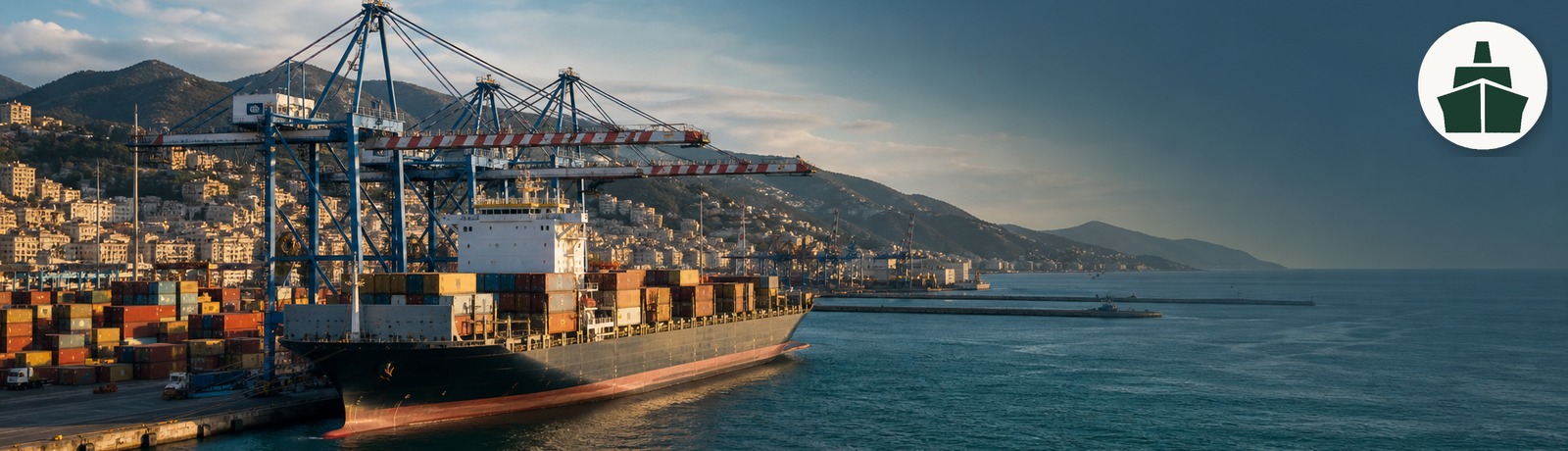
Italy is one of the most fragmented container origins in Europe. There is no single dominant gateway in the way Rotterdam dominates the Low Countries or Hamburg the German north. Instead there are nine or ten serious container ports spread across three coastlines, each with its own hinterland, its own carrier calls, and its own strengths and quirks. Choosing between them is not an administrative detail. On a UAE-bound shipment it is usually the decision that sets the transit time, the inland cost and the amount of handling the cargo takes before it ever reaches the water.
We have been moving cargo on the Italy–UAE lane for over ten years, working through established partners in Italy who handle the origin side directly. This note sets out how we look at the lane, port by port, and what we would want to know before recommending a routing.
The Italian gateways, and what each is actually good for
Ligurian range — Genoa and La Spezia
Genoa is Italy’s largest container port and the natural gateway for the industrial north-west — Piedmont, Lombardy, and the machinery and automotive supply chains around Turin and Milan. It carries the widest choice of direct and relay services to the Gulf, which matters when a sailing is missed and the next option needs to be a week away rather than three.
La Spezia is smaller and, for a certain kind of shipper, better. It is efficient, less congested than Genoa at peak, and it serves the Tuscan and Emilian industrial belt well. For marble, stone, mechanical components and mid-sized project pieces out of central-northern Italy, La Spezia frequently beats Genoa on total door-to-port cost even where the ocean leg looks similar.
Adriatic range — Trieste, Venice and Ravenna
Trieste is the deepest-water port on the list and the one with the strongest rail connection northwards into Austria, southern Germany, Hungary and the Czech Republic. It is also a free port with a distinctive customs regime. For UAE-bound cargo originating in the north-east, or consolidating from across the Alps, Trieste is often the shortest total transit even when the road leg looks longer on a map.
Venice serves the Veneto manufacturing base — furniture, textiles, machinery, glass. It has draft limitations that keep the largest vessels away, so most Gulf-bound boxes move on a feeder or relay leg. That is not a problem in itself; it simply needs to be planned for rather than discovered.
Ravenna is the specialist of the group. It handles more breakbulk, project and industrial cargo than its container volumes suggest, and it is the sensible choice for oversized pieces out of Emilia-Romagna that would be awkward to move overland to Genoa.
Tyrrhenian range — Livorno, Napoli and Salerno
Livorno is the Tuscan gateway and a strong option for automotive, machinery and project cargo, with good ro-ro capability alongside its container operation.
Napoli and Salerno together serve the Campanian industrial base and the wider Mezzogiorno. Salerno in particular is efficient for its size and well suited to the food, agricultural and processed-goods flows that move from southern Italy into the Gulf. Both are worth considering seriously for cargo originating south of Rome, where trucking north to Genoa can add more cost and risk than the ocean difference recovers.
Gioia Tauro — the transhipment hub
Gioia Tauro is different in kind from the others. It is a pure transhipment hub, positioned in Calabria on the main east–west Mediterranean lane, and it exists to move boxes between mother vessels rather than to serve a local hinterland. For Italy–UAE cargo its relevance is usually indirect: your container may well be relayed through Gioia Tauro even when it never appears in your routing conversation. Understanding that helps explain transit times that otherwise look inconsistent between two apparently similar bookings.
The three UAE destinations, and why the choice matters more than it used to
Jebel Ali remains the region’s primary gateway and the natural discharge point for cargo destined for Dubai, the northern emirates, and for onward consolidation or re-export. It is where our own cross-stuffing operation sits, which matters if your Italian cargo needs to be split between consignees, combined with cargo from another origin, or transferred into different equipment for an onward leg.
Fujairah sits on the Gulf of Oman, outside the Strait, and has become a serious alternative rather than a niche option. For cargo that is time-critical or that would otherwise be exposed to Gulf routing constraints, discharging at Fujairah and moving overland can be the more reliable answer.
Abu Dhabi (Khalifa Port) is the right discharge point for cargo destined for the emirate itself, for KIZAD-based industry, and for a good deal of oil, gas and energy-sector equipment. Delivering Abu Dhabi cargo through Jebel Ali and trucking it south is common practice and often unnecessary — on the right service, a direct Khalifa call removes a day and a handling.
What we actually do on this lane
The value in sea freight from Italy to the UAE is rarely in the ocean rate alone. It is in the decisions around it, including whether European pre-carriage should move by sea or through our Europe–Middle East road freight service.
- Choosing the port against the cargo, not the postcode. The nearest port is frequently not the cheapest once inland haulage, terminal handling and sailing frequency are counted. We would rather have that conversation before the booking than explain it afterwards.
- Consolidating multiple Italian suppliers into one container. Italian manufacturing is characterised by small and mid-sized specialist firms, and a UAE buyer is often purchasing from several at once. Collecting from each, consolidating at origin or at Jebel Ali, and issuing one bill of lading converts several part-loads and several freight bills into one.
- Handling the documentation properly at both ends. Export clearance in Italy, certificates of origin, chamber of commerce legalisation where the UAE consignee requires it, and import clearance in the UAE. A missing or inconsistent document is the single most common cause of a container sitting at a terminal accruing charges.
- Managing dangerous goods to the letter. IMDG classification, declarations and segregation, with the paperwork checked before the cargo reaches the terminal rather than after it is rejected there. Our dangerous goods reference covers the classes and the documents each attracts.
- Project and out-of-gauge engineering. Italian machinery and plant equipment frequently exceeds standard dimensions. Flat racks, open tops, lashing calculations and route surveys are ordinary work for us rather than an exception.
- Watching the free time. Detention and demurrage are decided before the vessel arrives, not after. We track the clock from the point of booking.
Ten years on the lane, and what that is worth
Longevity on a trade lane is easy to claim and worth being specific about. What ten years on Italy–UAE has actually given us is threefold.
The first is partners in Italy who do the origin work themselves. We are not booking through a broker who books through another broker. Our partners handle collection, export clearance and terminal delivery directly, which means when something moves — a cut-off brought forward, a vessel omitting a call — we hear about it from someone with hands on the cargo rather than two steps removed.
The second is working relationships with the major lines serving this trade. Rate is the least interesting part of that. What matters is equipment availability when boxes are tight, a realistic answer about whether a booking will actually load, and someone who will take a call about a rolled container. Those things are earned over years of volume and are not available on a spot platform.
The third is knowing where the lane goes wrong. Italian August closures. The difference between a quoted transit and a realistic one on a relay routing. Which ports handle a late document gracefully and which do not. That knowledge is unglamorous and it is most of the job.
We also operate our own NVOCC lines — PARS Line and PVS Shipping Line — issuing our own house bills of lading, which gives us routing control that a pure forwarder does not have.
Frequently asked questions
It depends on where your cargo is made, not where it is easiest to point at on a map. As a rough guide: the industrial north-west goes through Genoa or La Spezia; the north-east and anything consolidating from central Europe goes through Trieste or Venice; Tuscany through Livorno or La Spezia; Emilia-Romagna through Ravenna, particularly for project and breakbulk; and anything south of Rome should be looked at through Napoli or Salerno before assuming a long haul north. The right question is total cost and total transit door to door, including inland haulage and sailing frequency — not the ocean rate on its own. Send us the pickup postcode and the commodity and we will compare the realistic options.
Transit varies considerably by port, by carrier and by whether the routing is direct or relayed through a Mediterranean hub. A direct service from a Ligurian or Tyrrhenian port is materially faster than a relayed one from the Adriatic, and a booking that transhipes can add a week or more depending on connection timing. Rather than quote a figure that will be wrong for your specific booking, we give a realistic transit against the actual service at the time of quoting, and we tell you when a stated transit depends on a connection that may not hold. Current regional routing conditions are also affecting Gulf transits, and we factor that into what we tell you.
Yes, and on this lane it is one of the more valuable things we do. Italian manufacturing is dominated by specialist small and mid-sized firms, so a single UAE buyer is very often purchasing from three or four suppliers in different regions. We collect from each, consolidate into full container loads, and issue one bill of lading. Consolidation can happen at origin in Italy or at Jebel Ali depending on which produces the better result. Where cargo needs splitting between several UAE consignees on arrival, or combining with cargo from another country, our cross-stuffing facility at Jebel Ali handles the transfer, with a full tally and photographic record.
Jebel Ali suits cargo for Dubai and the northern emirates, and anything that needs consolidation, splitting or re-export — it is where the widest range of onward options sits. Abu Dhabi through Khalifa Port is the better answer for cargo destined for the emirate itself, for KIZAD industry and for much energy-sector equipment; routing it via Jebel Ali and trucking south is common and often adds an unnecessary day and an unnecessary handling. Fujairah sits outside the Strait on the Gulf of Oman and has become a genuine alternative where routing reliability matters more than the shortest paper transit. The right answer depends on the final delivery address and on how time-sensitive the cargo is.
Both, routinely. Italian exports to the Gulf include a great deal of chemical product, machinery and plant that falls outside standard dimensions. For hazardous cargo we prepare and check the IMDG declaration, safety data sheet and packing certificate before the container reaches the terminal, because a declaration rejected at the gate costs a day and a re-booking. Note that carrier acceptance for dangerous goods and out-of-gauge into the UAE is currently more restricted than usual and varies by line and by discharge port, so this needs confirming per shipment rather than assumed. Our dangerous goods reference sets out the classes and documentation, and we will tell you plainly if a routing is not currently available.
The core set is a commercial invoice, packing list, bill of lading and certificate of origin. Depending on the commodity and the consignee’s requirements you may also need chamber of commerce certification and legalisation, conformity or inspection certificates, and for hazardous cargo a full IMDG documentation set. Food, pharmaceutical, cosmetic and some electrical goods attract additional UAE requirements. The most common and most avoidable problem we see is inconsistency — a commodity described one way on the invoice and another on the bill of lading, or an HS code that does not match the goods. We check the set against both the export and import requirements before the container is loaded.
Both. We can quote port to port if you have your own inland arrangements in Italy, or handle the full movement from the supplier’s premises to the final delivery address in the UAE, including collection, export clearance, ocean freight, import clearance and last-mile delivery. On a multi-supplier consolidation, door-to-door is usually the more sensible structure because the coordination between collections is where the schedule actually gets decided. Tell us what you already have in place and we will quote the part you need.
Getting a realistic answer for your shipment
Every routing recommendation on this lane depends on details a rate sheet cannot capture: where the goods are made, what they are, how urgent they are, and where they need to end up. If you tell us those four things we will come back with a comparison of the realistic options rather than a single number, and we will say plainly where the risks sit.
Send us the shipment details and we will work it through with you.
Published 26 August 2026 · updated 30 August 2026 · All insights →